wire bay · hedge-trimmings-chipped-two-year-cureRunning
Hedge trimmings, chipped, and left for eight months
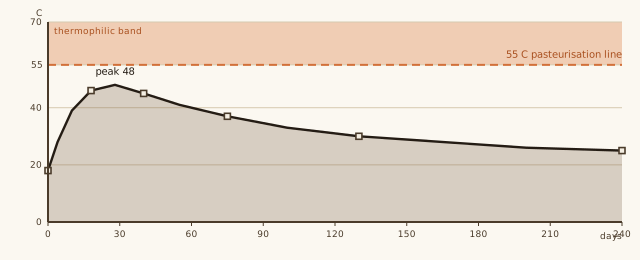
- day in bin
- 150
- C:N in
- 35:1
- water in
- 39%
- peak
- 48 °C
One bench, logged in full
A season of home composting recorded at a single bench: the feedstock weights as they went in, the C:N calculated before the pile was built, the moisture at every turn, and the temperature curve the pile actually ran — including the weeks it stalled, soured, or cooked itself past 70 °C.
Enter what you have and the arithmetic updates as you type. It runs entirely in your browser — nothing is sent anywhere — and the same method is written out in the C:N and moisture calibration log.
Blended C:N
—
waiting for input
Blended moisture
—
waiting for input
waiting for input
The most recent batches in the record, with the day count since charge and the curve each one actually ran.
wire bay · hedge-trimmings-chipped-two-year-cureRunning
worm tray · worm-tray-kitchen-scrap-onlyCured
pallet bin · spent-mushroom-substrate-recycleCured
Start from the symptom. Thirty faults, each with the cause and what to do about it.
The methods the batches above were run under.
Newest first. Batch logs, method write-ups and reference tables post as the season runs.
Batch log
Not everything in a compost bay is trying to be a hot pile. 300 L of chipped privet and hawthorn took 240 days and produced the best mulch in the garden.
Method
Sometimes the right place to put 80 kg of compostable material is not a bin at all. A sheet-mulched bed converts lawn into growing space in one afternoon, using the same carbon and…
Batch log
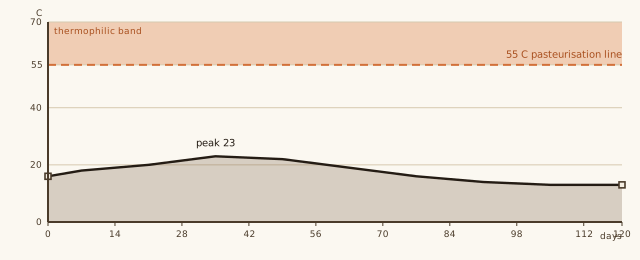
No heat, no turning, no smell — but a 20 °C temperature ceiling that makes or breaks the whole system, and the pH drift that a strictly kitchen-scrap diet causes.
Reference
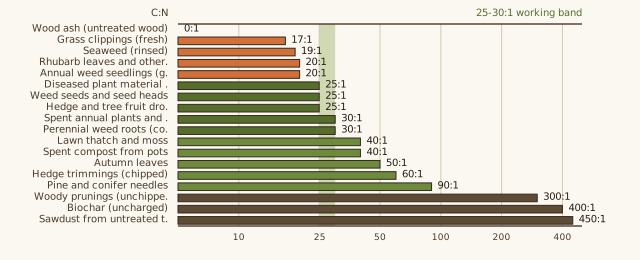
Eighteen materials from the garden, including the four that should never go in a compost pile at all — not because they will not break down, but because they will break down into something…
Batch log
120 kg of spent oyster-mushroom blocks, already white with mycelium, and why the single most important step is breaking the blocks apart on the day they arrive.
Method
Not every pile is a project. A passive stack on the ground, built once, turned once, produces compost and leaf mould with about twenty minutes of work a year — and it is the right method…
Every published batch side by side, so the numbers can be read across the season rather than one page at a time.
| batch | bin | kg in | C:N in | water in | days | peak °C | state |
|---|---|---|---|---|---|---|---|
| hedge-trimmings-chipped-two-year-cure | wire bay | 200.0 | 35:1 | 39% | 240 | 48 | Running |
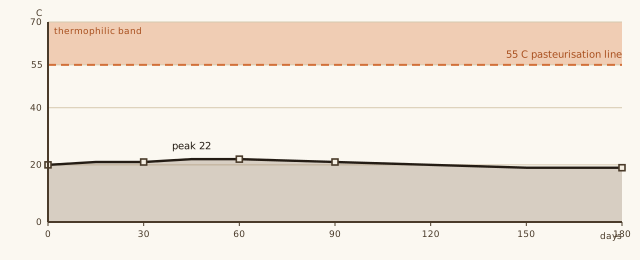
| worm-tray-kitchen-scrap-only | worm tray | 62.7 | 20:1 | 65% | 180 | 22 | Cured |
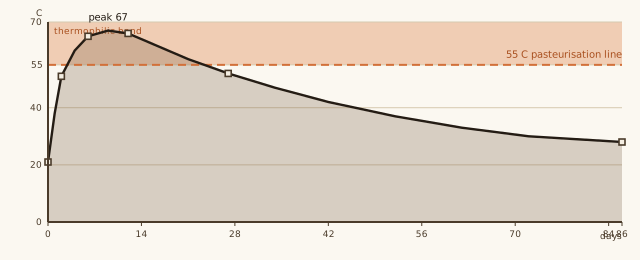
| spent-mushroom-substrate-recycle | pallet bin | 142.5 | 39:1 | 60% | 86 | 67 | Cured |
| municipal-green-waste-windrow | windrow | 592.0 | 41:1 | 48% | 110 | 78 | Cured |
| poultry-litter-sawdust-winter-bin | insulated bin | 104.0 | 17:1 | 49% | 148 | 58 | Cured |
| office-shred-and-cardboard-cube | insulated bin | 40.9 | 9:1 | 35% | 96 | 64 | Curing |
| bokashi-bran-then-outdoor-burial | sealed bucket | 86.6 | 16:1 | 41% | 68 | 25 | Cured |
| horse-manure-straw-pallet-bin | pallet bin | 129.0 | 32:1 | 50% | 132 | 64 | Cured |
| grass-clippings-cardboard-cage | wire bay | 15.5 | 23:1 | 46% | 88 | 68 | Cured |
| oak-leaf-coffee-chaff-crib | tumbler | 43.9 | 32:1 | 44% | 74 | 63 | Cured |
The same five numbers appear on every batch page, in the same order.
Every batch page opens with the sheet: each feedstock with its weight, its C:N and its moisture as it went in, and the carbon that row contributes. The blend row at the foot is the arithmetic result — not the plan. Where the two disagree, both are shown.
Carbon equivalent is weight × C:N/(C:N+1). It is the honest way to add a 350:1 cardboard to a 20:1 coffee ground, because the ratio alone tells you nothing about mass. Materials entered at 0:1 — water, ash, minerals — are excluded from the ratio and counted only where they change moisture.
Moisture is a squeeze test at the bench and a dried sample once a month. The squeeze test is good to about ±5 %: holds together with a faint sheen and no drips is the target, and it is what the water column in each sheet records.
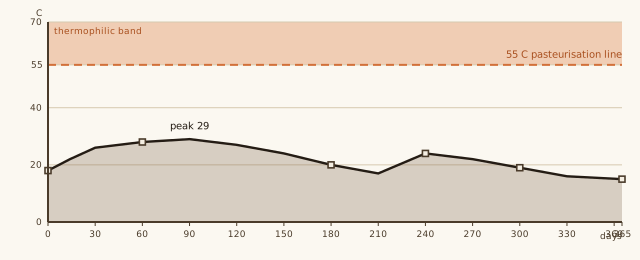
The curve at the foot of the page is drawn from readings taken 30 cm into the core before and after every turn. The dashed line at 55 °C is the pasteurisation line — three consecutive days above it is the working definition of a hot batch, and no page claims it unless the curve shows it. Squares mark the days the pile was turned, which is why the curve often steps down at a square.
