Method · wire bay · posted 29 Aug 2026
The 18-day hot method, and why the size rule is not negotiable
Turn every second day, keep the pile above 55 °C, and you can have finished compost in under three weeks. The catch is that the method only works above a minimum volume, and below it you are just making a slow pile faster for no reason.
01The sheet
| material | kg in | C:N | water | role | carbon |
|---|---|---|---|---|---|
| Mixed green waste, chopped to 5 cm | 30.0 | 20:1 | 72% | green | 28.6 |
| Straw or hay, chopped | 20.0 | 70:1 | 14% | brown | 19.7 |
| Shredded paper or cardboard | 8.0 | 250:1 | 9% | brown | 8.0 |
| Manure (any) as a nitrogen starter | 15.0 | 18:1 | 55% | green | 14.2 |
| Blended | 73.0 | 28:1 | 46% | 70.5 kg C-eq | |
02Batch facts
- Bin
- wire bay
- Thermal class
- Thermophilic (crossed 55 °C)
- Turns
- 7
- Days to finish
- 18
- Target C:N
- 30:1 (as charged 28:1)
- Moisture at build
- 55 % (as charged 46 %)
- Odour risk
- low
- Space needed
- Three cubic feet minimum is the classic figure; in metric, 0.9 m³ — a 1 m cube, or four 1 m wire bays used in rotation.
- Time to finish
- 18 days from first build to finished compost, then a 30-day cure before use.
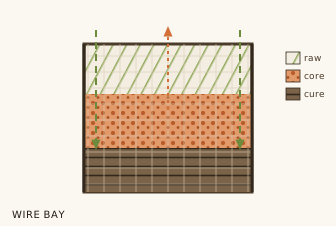
Drawn to the shape of this container and its working volume. Dashed arrows are airflow; hatching is the hot core that holds the temperature curve above.
03The volume rule
The classic minimum for the 18-day method is 3 cubic feet, or just under 0.1 m³ — but that figure comes from a climate with warm summers and it is optimistic for a temperate garden. In practice 0.9 m³ (a 1 m cube) is the smallest pile that will hold 55 °C for the required three days when ambient is 15-20 °C. Below that, surface area overwhelms volume and the pile cannot retain its own heat between turns. If you only have a 200 L tumbler, the 18-day schedule is not available to you; a 60-90 day tumbler cycle is the realistic target.
04Why every second day, and not daily
Turning daily sounds more diligent but is counterproductive: each turn dumps the accumulated heat and the pile spends a day climbing back. Turning every second day keeps the core above 55 °C for most of the interval while still moving the outer material into the middle often enough that nothing stays cold for long. If the pile is below 55 °C on turn day, the interval is not the problem — the size, moisture or C:N is.
05Chop size decides everything
Two-centimetre material will run the 18-day schedule; 10 cm material will run it in 35 days at best, because the surface area available to microbes is a quarter of what it was. Hedge trimmings straight from the loppers are the worst case. A shredder is not necessary — a sharp spade on a paved surface, or a mower run over a tarp of trimmings, will get most material to 3-5 cm in ten minutes.
06What the 18 days does not include
Compost that finishes the hot phase on day 18 is not finished compost. It still needs 30 days of curing, during which the fungal community moves in and the material becomes stable and plant-safe. Applying day-18 material directly will burn seedlings with ammonia and can carry viable weed seeds that survived the parts of the pile that never reached 55 °C. Cure it in a covered heap, turning once a fortnight, and it will be ready when the temperature has been ambient for two weeks.
07Turn schedule
- day 0 Build the whole pile in one session with everything chopped to 5 cm or less. Chop size is what decides whether the 2-day interval works.
- day 2 Turn 1. Bring the outside to the middle and the middle to the outside; this is what makes the whole pile pass through the hot core.
- day 4 Turn 2. Add water only if the squeeze test leaves no sheen.
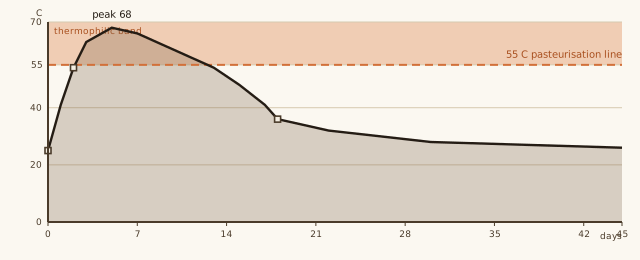
- day 6 Turn 3. Peak readings of 65-68 °C are normal and safe at 55 % moisture.
- day 8 Turn 4. Pile starts to shrink visibly, roughly 20 % by volume since day 0.
- day 12 Turn 6. Temperature is falling; the material is now dark and crumbly.
- day 18 Turn 9. Temperature is ambient and the pile has a uniform earthy smell. Move to the cure stage or screen and use.
08Temperature curve, as it ran
Smell notes
The hallmark of a working Berkeley pile is that it does not smell at all — a faint sweet hay note at most. If you can smell it from three metres, one of three things is wrong: it is too wet, it has not been turned on schedule, or the pieces are too large and the middle has gone anaerobic. Ammonia means too much nitrogen; vinegar means too little air. Both are corrected by the same action, which is turning and adding dry brown material.
09Questions this batch raised
- Can I use the 18-day method all year?
- In summer, yes. In winter the same pile will stall at the start and the schedule becomes meaningless; either insulate heavily or switch to a slow pile for the cold months. The method depends on the pile reaching 55 °C within 48 hours, and in January that is not going to happen without a large mass and warm water.
- Does the pile have to reach 55 °C?
- For the pathogen and weed-seed kill that makes the method worth doing, yes. A pile that peaks at 45 °C still makes compost, just more slowly, and cannot be relied on to kill seeds. Measure the core with a 50 cm compost thermometer, not with your hand on the outside.
10Faults this batch illustrates
- The pile will not heatTemperature sits within 5 °C of ambient for a week or more. The material looks fine and does not smell.
- Ammonia smellA sharp, cleaning-product smell at the vent or when the lid is opened, often strongest in the first week.
- Pile runs above 70 °CCore readings above 70 °C, a sharp smell of scorching, and visible white ash-grey microbial bloom.