Method · tumbler · posted 24 Sep 2026
Running a tumbler properly: two charges, not one
Tumblers fail in a specific and predictable way — the material balls up, the middle goes anaerobic and the temperature collapses. The fix is partly technique and partly running two charges in rotation so you never have to rush a batch.
01The sheet
| material | kg in | C:N | water | role | carbon |
|---|---|---|---|---|---|
| Kitchen waste (chopped small) | 12.0 | 17:1 | 80% | green | 11.3 |
| Shredded cardboard | 9.0 | 350:1 | 8% | brown | 9.0 |
| Shredded leaves | 6.0 | 50:1 | 25% | brown | 5.9 |
| Grass clippings (dried) | 2.5 | 24:1 | 34% | green | 2.4 |
| Blended | 29.5 | 31:1 | 43% | 28.6 kg C-eq | |
02Batch facts
- Bin
- tumbler
- Thermal class
- Thermophilic (crossed 55 °C)
- Turns
- 7
- Days to finish
- 70
- Target C:N
- 28:1 (as charged 31:1)
- Moisture at build
- 55 % (as charged 43 %)
- Odour risk
- medium
- Space needed
- One 150-200 L dual-chamber tumbler on a level, hard surface.
- Time to finish
- 60-90 days per charge, running two overlapping charges so output is continuous rather than in bursts.
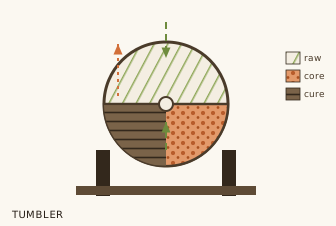
Drawn to the shape of this container and its working volume. Dashed arrows are airflow; hatching is the hot core that holds the temperature curve above.
03Why tumblers stall in the middle
A tumbler's advantage is aeration and its disadvantage is the same thing: everything rolls. Wet kitchen waste forms balls 10-15 cm across within about four days, and the interior of each ball is anaerobic. Temperature readings look fine because the probe hits the dry material between the balls; the smell at the vent tells the truth. Breaking up balls at every turn for the first two weeks is the single habit that separates a tumbler that works from one that stalls at 40 °C.
04The 70 % rule
A tumbler charged to the top cannot mix: there is no headspace for material to fall through, so the whole mass rotates as a cylinder. Seventy per cent is the practical maximum, and 60 % is better. The corollary is that a 190 L tumbler holds about 120 L of working material, which means the throughput is lower than the drum size suggests — roughly 40 kg of input per cycle, not 190 L.
05Two charges, and why it matters
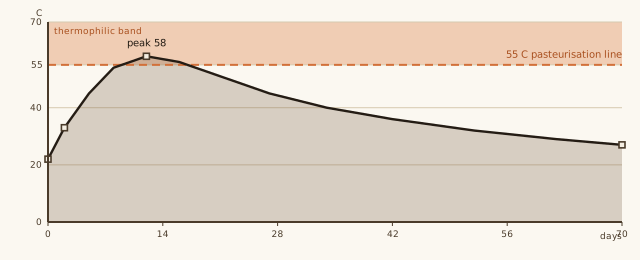
Running two overlapping charges — one heating, one curing — turns a tumbler from a batch device into a continuous one. In this cycle the hot chamber takes 26 days and the curing chamber 44, so the total is 70 days per charge but a finished batch comes out every 44 days. It also removes the temptation to shortcut: if you know the next charge is already heating, you are far less likely to screen a batch that is not ready.
06The cure is not optional
Tumbler compost looks finished long before it is. It comes out dark and crumbly at day 26, but it is still biologically active and can be quite salty from kitchen waste. Forty-four days in the second chamber, tumbled once a week, gives a material that will not burn seedlings and that holds moisture well in a potting mix at 20 % by volume. Skipping the cure is the most common reason people conclude that tumbler compost 'is not as good' as heap compost.
07Turn schedule
- day 0 Charge chamber one to no more than 70 % full — a tumbler packed tight cannot tumble, it just rotates as a block.
- day 0 Tumble 20 revolutions immediately after charging; this is the mix that decides the first week.
- day 2 Tumble 10 revolutions. Break any ball of material you can see through the hatch with a stick.
- day 6 Tumble 10 revolutions. Check for a sour smell at the vent, which indicates a balled core.
- day 12 Tumble, then leave alone for four days. Over-tumbling in the hot phase loses heat for no benefit.
- day 26 Move the charge to chamber two to cure, and charge chamber one with the next batch on the same day.
- day 70 Screen chamber two at 10 mm and use; the cycle then repeats every 44 days.
08Temperature curve, as it ran
Smell notes
Two distinct smells tell you different things in a tumbler. A sour, yeasty smell through the vent means material has balled up and the centre has gone anaerobic — open the hatch and break it apart by hand. An ammonia smell means the charge is too nitrogen-heavy, usually because too much kitchen waste went in without enough cardboard. Both are fixed by the same first step, which is tumbling and inspecting, and the second step differs: cardboard for ammonia, breaking up balls for sour.
09Questions this batch raised
- Do I need to add a starter or accelerator?
- No. Commercial accelerators are mostly nitrogen and enzymes, and the same effect comes from 1 kg of fresh grass or a handful of finished compost. What a tumbler actually needs is enough cardboard and enough tumbling, and neither can be bought in a bottle.
- How often should I tumble?
- Every two days while the pile is heating, and once a week during the cure. Tumbling more often than that loses heat without speeding anything up. A tumbler that is turned five times a day by an enthusiastic household will run cooler than one turned every second day.
10Faults this batch illustrates
- Material balls up in a tumbler10-15 cm balls of wet material visible through the hatch, a sour smell at the vent, and a temperature stuck around 40 °…
- Sour or rancid smellA vinegar, silage or rancid-butter smell, usually with a temperature drop of several degrees.
- Ammonia smellA sharp, cleaning-product smell at the vent or when the lid is opened, often strongest in the first week.