Batch log · worm tray · posted 19 Oct 2026
A four-tray worm system on kitchen scraps, nine harvests in
No heat, no turning, no smell — but a 20 °C temperature ceiling that makes or breaks the whole system, and the pH drift that a strictly kitchen-scrap diet causes.
01The sheet
| material | kg in | C:N | water | role | carbon |
|---|---|---|---|---|---|
| Vegetable and fruit trimmings | 42.0 | 16:1 | 84% | green | 39.5 |
| Shredded newspaper (bedding) | 9.0 | 175:1 | 8% | brown | 8.9 |
| Cardboard egg trays (torn) | 3.5 | 200:1 | 9% | brown | 3.5 |
| Coffee grounds (with paper filter) | 7.0 | 20:1 | 60% | green | 6.7 |
| Crushed eggshell, ground | 1.2 | 0:1 | 3% | balancer | — |
| Blended | 62.7 | 20:1 | 65% | 58.6 kg C-eq | |
02Batch facts
- Bin
- worm tray
- Charged
- 08 Feb 2026
- Finished
- 07 Aug 2026
- Thermal class
- Mesophilic (stayed below 55 °C)
- Turns
- 6
- Days to finish
- 180
- Finished volume
- 96 L
- Target C:N
- 25:1 (as charged 20:1)
- Moisture at build
- 76 % (as charged 65 %)
- Odour risk
- low
- Space needed
- A four-tray worm system indoors at 16-22 °C, on a tray with a lip to catch drips.
- Time to finish
- 180 days is a continuous process, not a batch — the figure here is nine harvest cycles' worth of castings.
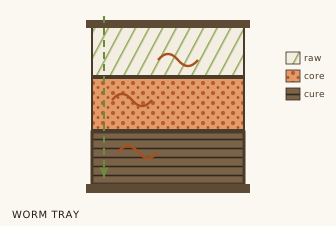
Drawn to the shape of this container and its working volume. Dashed arrows are airflow; hatching is the hot core that holds the temperature curve above.
03The 20 °C ceiling
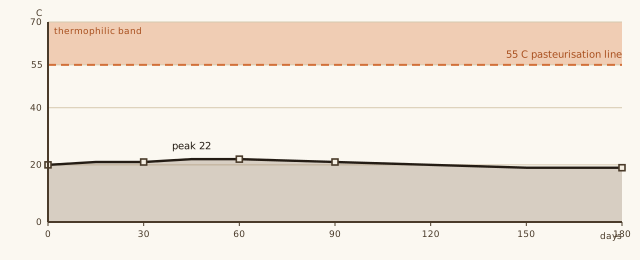
Eisenia fetida processes food fastest at 18-22 °C. At 25 °C it starts to lose weight; at 30 °C it dies within days. This is the constraint that decides where a worm tray can live: a kitchen corner in a temperate flat is ideal, a south-facing balcony in summer is fatal, and an unheated garage in a cold winter is nearly as bad, since feeding stops below 10 °C. Over the 180 days logged here the tray held 19-22 °C, which is why the weekly throughput stayed at 700 g.
04Feeding rate is arithmetic, not intuition
The working figure is that worms eat roughly half their body weight a day, but that is under ideal conditions and with a fully established population. In practice, start at 200 g a week for 500 g of worms and double the rate every three weeks while the food is gone within five days. This tray settled at 700 g a week for a 1.2 kg population — about 8 % of body weight per day, well below the theoretical maximum, because kitchen scraps are 84 % water and the dry matter intake is what actually matters.
05The pH drift nobody mentions
A diet of nothing but vegetable trimmings and coffee grounds pushes castings acidic — this tray read pH 5.8 at day 75, low enough to stress the worms and to make the castings a poor match for most vegetables. Ground eggshell at 40 g a week moved it to 6.4 by day 90 and held it there. Crushed shells straight from the kitchen are too coarse to dissolve usefully; grind them to a powder, or use agricultural lime at a quarter of the rate.
06Harvesting without a migrator
The simplest harvest at this scale needs no equipment: stop feeding the working tray for a week, put a tray of fresh bedding with one small feed on top, and the worms migrate up through the drainage holes over three days. What is left behind is castings with maybe 2 % residual worms, which is fine for garden use. A 3-day migration in this tray left about 11 L of castings per cycle and lost very few worms.
07What the castings are good for
96 L over nine harvests, with a nutrient profile of 1.5 % nitrogen, 1.2 % phosphorus and 1.0 % potassium — higher than any compost in this log, and with a microbial count that makes it a better inoculant than a fertiliser. Use it at 10-20 % by volume in seed-raising mix, or as a 1 cm top dressing. It is too valuable to spread at 5 L/m² like garden compost.
08Turn schedule
- day 0 Set up four trays, fill the working tray with moist newspaper bedding and 500 g of Eisenia fetida.
- day 7 First feed: 400 g of trimmings buried in one corner. Bury, do not scatter on the surface.
- day 30 Feed rate stable at 700 g a week. Check tray temperature — 22 °C is the ceiling.
- day 60 First harvest: move the working tray to the top of the stack and let the worms migrate down over 3 days.
- day 90 pH check on the castings: 6.4. Add the ground eggshell at 40 g a week to hold it there.
- day 180 Ninth harvest: 96 L of castings total, at roughly 11 L per harvest. Start a second working tray.
09Temperature curve, as it ran
Smell notes
A worm tray in good order smells of wet earth and nothing else. The two smells that matter are different failures: a sour, fermenting smell means you buried more food than the worms can process in a week, and an ammonia smell means the bedding has gone too wet and too nitrogen-rich at once. Both are corrected the same way — stop feeding for 10 days, fluff the bedding, add dry shredded paper, and remove anything uneaten.
10Questions this batch raised
- Can worms live on nothing but kitchen scraps?
- They survive, but the system is easier to run with bedding added. Worms need the carbon fibre in shredded paper or cardboard to keep the tray from going wet and acidic, and the bedding is what makes handling pleasant. A purely kitchen-scrap tray works if you are strict about draining and about never overfeeding.
- What can I not put in a worm tray?
- Meat, fish, dairy, oils and anything cooked in oil — they rot rather than decompose and attract rodents. Citrus and onion in quantity push the pH down. Do not add pet waste or anything from a treated lawn. Coffee grounds, tea leaves, eggshells, vegetable trimmings and fruit in moderation are all fine.
11Faults this batch illustrates
- Fruit flies around the worm traySmall flies in the air around the tray, and maggots in any food that is sitting on the surface.
- Worm tray has gone wet and smellsLiquid at the bottom of the tray, bedding that drips when squeezed, and a sour or ammonia smell.
- Worms climbing the wallsWorms massed on the inside walls and under the lid, or found dead on the floor around the tray.