Batch log · sealed bucket · posted 13 Sep 2026
Bokashi bran for 14 days, then a buried trench for 54 days
The indoor answer for a flat with no garden: 38 kg of food waste fermented in two buckets, buried in a 2 m trench, and the pH readings that decide when the soil is safe for roots.
01The sheet
| material | kg in | C:N | water | role | carbon |
|---|---|---|---|---|---|
| Mixed kitchen food waste (no liquids) | 38.0 | 18:1 | 71% | green | 36.0 |
| Bokashi bran (wheat bran + EM inoculant) | 3.6 | 22:1 | 28% | balancer | 3.4 |
| Sawdust (trench mix, dry) | 5.0 | 400:1 | 11% | brown | 5.0 |
| Trench soil (backfill) | 40.0 | 12:1 | 18% | balancer | 36.9 |
| Blended | 86.6 | 16:1 | 41% | 81.4 kg C-eq | |
02Batch facts
- Bin
- sealed bucket
- Charged
- 02 May 2026
- Finished
- 09 Jul 2026
- Thermal class
- Mesophilic (stayed below 55 °C)
- Turns
- 7
- Days to finish
- 68
- Finished volume
- 74 L
- Target C:N
- 22:1 (as charged 16:1)
- Moisture at build
- 48 % (as charged 41 %)
- Odour risk
- low
- Space needed
- Two 20 L sealed buckets with taps indoors, then 2 m of trench or one 60 L planting hole outdoors.
- Time to finish
- 14 days in the bucket, then 54 days buried before planting over the trench.
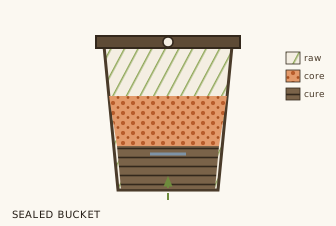
Drawn to the shape of this container and its working volume. Dashed arrows are airflow; hatching is the hot core that holds the temperature curve above.
03What bokashi is and is not
Bokashi is lactobacillus fermentation in a sealed bucket. The food waste does not break down in the bucket — it is preserved, pH dropping to about 3.5 as lactic acid accumulates. That acidity is what kills the smell and stops putrefaction. Nothing is mineralised: you get the same 38 kg of material out that you put in, only pickled. The decomposition happens later, in soil, which is why a bokashi system needs somewhere to bury the output or a separate compost heap to add it to.
04Bran dose and moisture
The bran dose is commonly over-applied. The working rate here was 90 g per 2.5 kg of waste — about 3.6 kg of bran for 38 kg of food, which is 9.5 % by weight. More bran does not make it ferment faster; it just adds carbon you have to account for at the burial stage, and the wheat bran itself is 22:1. What matters more is pressing each layer down and keeping the lid sealed. Liquid on the surface is fine; air pockets are not.
05The burial arithmetic
A 20 L bucket of fermented waste is far too concentrated to plant into directly. Standard practice is to bury it 15-20 cm below the surface with soil on both sides, which is what the 2 m trench did: 5 cm layers of waste alternating with 5 cm of soil, ending with 15 cm of backfill. Add the 5 kg of sawdust if the trench soil is heavy clay, as it was here — the carbon soaks up the liquid that would otherwise sit in a cold, sour pocket all winter.
06Reading the pH before you plant
The trench line read pH 4.8 at day 20, 5.9 at day 34 and 6.8 at day 54. Two things matter for roots: the acidity itself, which is why you wait, and the temporary nitrogen drawdown as soil microbes multiply to consume the fermented sugars. Courgettes went in on day 68 and showed no yellowing; a faster crop like salad leaves sown at day 30 would have stalled for three weeks. If you want to plant sooner, mix the fermented waste into a working compost heap at 1 part bokashi to 5 parts browns instead of trenching it.
07Throughput for a two-person flat
Two 20 L buckets in rotation handled 38 kg of food waste in 14 weeks — about 2.7 kg a week. That is the real figure to check before starting: a two-person household in Europe or North America typically produces 4-6 kg of food waste a week, so either add a third bucket or accept that some waste still goes out. The leachate was about 1.2 L per bucket and went on the balcony pots at 1:100.
08Turn schedule
- day 0 Fill bucket 1 to 80 % with chopped food waste, add 90 g of bran per 2.5 kg and press down to exclude air.
- day 1 Open the tap and drain leachate. Dilute 1:100 as a liquid feed or pour it down the drain undiluted to clear it.
- day 5 Second fill: add another 3 kg of waste and 100 g of bran, press down again.
- day 14 Bucket 1 is ready when the surface has a white mould film and smells of pickles, not rot. Dig the 2 m trench.
- day 16 Layer fermented waste 5 cm deep in the trench, cover with 5 cm of soil, repeat, finish with 15 cm of soil.
- day 34 Check pH at 20 cm in the trench line. Aim for 6.5-7.0 before sowing anything.
- day 68 Plant over the trench line: courgettes went in at this point with no fertiliser for the season.
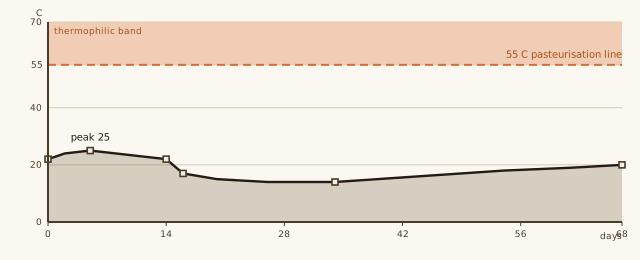
09Temperature curve, as it ran
Smell notes
Bokashi is a fermentation, not a decomposition, and the smell follows: pickled vegetables, cider vinegar, a faint yeast note. If the bucket smells of rotten eggs or sewage, the mix has gone anaerobic in the wrong direction — usually too much liquid and not enough bran. The soil stage is where people get surprised: for the first 10 days after burial a trenched bokashi can smell distinctly sour if you dig into it. Leave it alone and it is gone by day 20.
10Questions this batch raised
- Can I put citrus, onion and cooked food in?
- Yes, all three, in the quantities a normal kitchen produces. The old advice to exclude citrus comes from worm bins, where acidity genuinely harms the worms. In a bokashi bucket the lactic acid bacteria handle citrus peel, onion skins, bones, dairy and cooked food; keep liquids out, since they dilute the fermentation.
- Can the finished product go straight onto the garden?
- Not straight onto roots. It is pH 3.5-4 when it comes out of the bucket. Either trench it 20 cm down and wait 6-8 weeks, or mix it into a compost heap at 1:5 with browns, where it will finish in about a month.
11Faults this batch illustrates
- Bokashi bucket smells rottenRotten eggs, sewage or a strong faecal smell when the bucket is opened, instead of the expected pickle smell.
- No white mould on the bokashi surfaceAfter two weeks the surface shows no white fungal film and the contents look unchanged.
- Buried bokashi still sour after weeksDigging into a bokashi trench after three or four weeks finds recognisable, sharply acidic material.