Method · wire bay · posted 08 Oct 2026
Cold composting: the pile that takes a year and needs almost nothing
Not every pile is a project. A passive stack on the ground, built once, turned once, produces compost and leaf mould with about twenty minutes of work a year — and it is the right method for most households most of the time.
01The sheet
| material | kg in | C:N | water | role | carbon |
|---|---|---|---|---|---|
| Autumn leaves (whole, not shredded) | 40.0 | 50:1 | 25% | brown | 39.2 |
| Hedge trimmings (unchipped) | 18.0 | 45:1 | 30% | brown | 17.6 |
| Kitchen waste (added on top through the year) | 30.0 | 17:1 | 80% | green | 28.3 |
| Grass clippings (thin layers only) | 12.0 | 17:1 | 76% | green | 11.3 |
| Garden soil (a spadeful per layer) | 18.0 | 12:1 | 20% | balancer | 16.6 |
| Blended | 118.0 | 23:1 | 44% | 113.1 kg C-eq | |
02Batch facts
- Bin
- wire bay
- Thermal class
- Mesophilic (stayed below 55 °C)
- Turns
- 6
- Days to finish
- 365
- Target C:N
- 35:1 (as charged 23:1)
- Moisture at build
- 50 % (as charged 44 %)
- Odour risk
- low
- Space needed
- Two wire bays, 1 m each, and a willingness to leave one of them alone for a year.
- Time to finish
- 9-14 months, with a single turn in the middle and no temperature management at all.
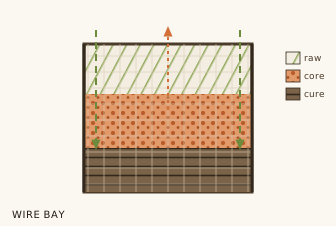
Drawn to the shape of this container and its working volume. Dashed arrows are airflow; hatching is the hot core that holds the temperature curve above.
03What cold composting actually does
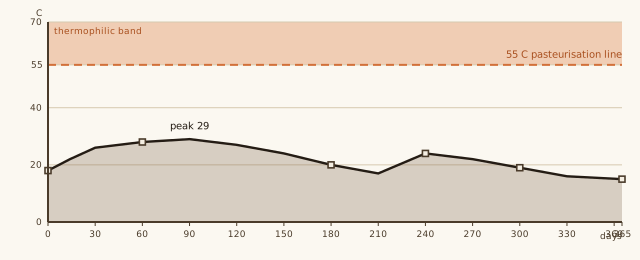
A passive stack works on fungal decomposition rather than bacterial heat. Fungi and invertebrates — earthworms, woodlice, millipedes — do the work over months instead of weeks. Because the pile never reaches 55 °C, it does not kill weed seeds or pathogens, which is the real cost of the method. What you get in exchange is a process that tolerates almost any input, requires no temperature monitoring, and cannot fail in the way a hot pile can: it simply takes longer.
04The weed seed trade-off
Cold compost will germinate weeds. That is not a reason to avoid the method, but it does dictate where the compost goes. Use it as a top dressing in perennial beds, around established shrubs, or as a mulch layer under fruit trees, where a few germinating seeds are pulled in minutes. Do not use it in a seed-raising mix or in a fine-tilled vegetable bed where hand-weeding a thousand seedlings is the alternative. If you have a persistent problem with bindweed, ground elder or horsetail, keep those roots out of a cold stack entirely.
05The one turn matters more than it sounds
The day-180 turn does three things: it redistributes material that has already broken down into the zones where decomposition is slowest, it introduces a burst of oxygen, and it lets you see and correct the wet layer at the base. Skipping it costs about three months. Doing it twice a year would cost more heat than it returns. One turn, halfway through, is the whole schedule.
06Leaf mould is a separate product
The leaves in a cold stack do not all break down in a year — the 60 L of oversize at screening is leaf mould in progress. Leaf mould is a distinct product: low in nutrients, high in fungal biomass, superb as a seed-sowing component and as a soil conditioner. Give it its own wire ring for a second year rather than mixing it back into the compost, where it will slow the next batch.
07Turn schedule
- day 0 Build the stack directly on soil, alternating 20 cm of leaves with a thin scatter of greens and a spadeful of soil.
- day 60 Add nothing and turn nothing. The only work in the first two months is burying kitchen waste 20 cm down in the core.
- day 180 The single turn of the whole cycle: move the stack to the second bay, moving the outside to the inside.
- day 240 Temperature bump to 24 °C from the turn — a small, short-lived exotherm, not a hot phase.
- day 300 Stop adding anything new from here. The stack now needs to sit and finish.
- day 365 Screen at 15 mm: roughly 120 L of compost plus 60 L of leaf mould that needs another year to become fine.
08Temperature curve, as it ran
Smell notes
A cold pile smells of the forest — leaves, soil, a little mushroom. It never develops the sharp notes a badly managed hot pile can, mostly because it never gets hot enough to volatilise nitrogen. The two problems to watch for are a wet, sour bottom layer where the stack meets the ground, and a mat of slimy grass clippings if they are added in layers more than 3 cm thick. Both are avoided at build time rather than fixed afterwards.
09Questions this batch raised
- Is cold compost safe to use on vegetables?
- Yes, with the understanding that it may carry weed seeds, and that material added in the last three months may still be recognisable. Keep it to top dressing and mulching rather than digging in fresh, and do not use cold compost from a pile that received pet waste or dairy.
- Can I put everything in a cold pile?
- Anything you would put in a hot pile, plus things a hot pile struggles with: woody prunings, whole leaves, conifer trimmings, and small quantities of material that would slow a fast batch. What it cannot handle is anything that attracts rodents unless buried 20 cm deep, and perennial weed roots.
10Faults this batch illustrates
- The pile will not heatTemperature sits within 5 °C of ambient for a week or more. The material looks fine and does not smell.
- Slimy grass layerA black, slippery layer of grass in the middle of the pile, with a sewage-like smell when it is broken open.
- Wet, sour layer at the baseThe lowest 15 cm of a ground pile is dark, wet and sour-smelling even when the rest of the pile is fine.