Method · wire bay · posted 10 Sep 2026
Working out C:N and moisture before the pile is built
Every smell problem in this log traces back to a ratio that was wrong before the material went in. The arithmetic takes ten minutes, needs nothing but a scale, and prevents most of what goes wrong afterwards.
01The sheet
| material | kg in | C:N | water | role | carbon |
|---|---|---|---|---|---|
| Example: dry autumn leaves | 10.0 | 50:1 | 25% | brown | 9.8 |
| Example: fresh grass clippings | 10.0 | 17:1 | 78% | green | 9.4 |
| Example: kitchen vegetable waste | 5.0 | 17:1 | 80% | green | 4.7 |
| Example: shredded cardboard | 4.0 | 350:1 | 8% | brown | 4.0 |
| Blended | 29.0 | 27:1 | 50% | 28.0 kg C-eq | |
02Batch facts
- Bin
- wire bay
- Thermal class
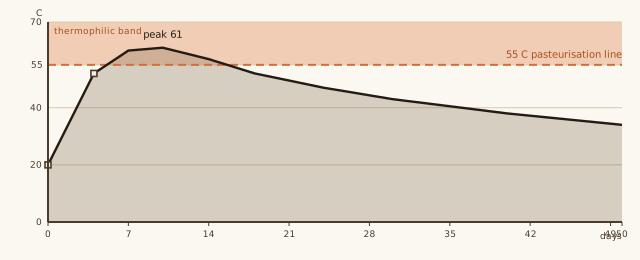
- Thermophilic (crossed 55 °C)
- Turns
- 5
- Days to finish
- 0
- Target C:N
- 30:1 (as charged 27:1)
- Moisture at build
- 55 % (as charged 50 %)
- Odour risk
- low
- Space needed
- No space needed — a kitchen scale, a notebook and about ten minutes per batch before it is built.
- Time to finish
- Ten minutes of arithmetic before you build, which is what decides whether the next 90 days go well.
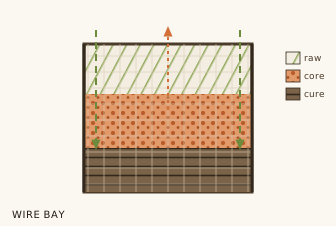
Drawn to the shape of this container and its working volume. Dashed arrows are airflow; hatching is the hot core that holds the temperature curve above.
03The carbon and nitrogen arithmetic, worked once
Take the example above: 10 kg of leaves at 50:1, 10 kg of grass at 17:1, 5 kg of kitchen waste at 17:1, 4 kg of cardboard at 350:1. Carbon in the leaves is 10,000 × (50/51) = 9,804 g and nitrogen is 10,000/51 = 196 g. Grass: 10,000 × (17/18) = 9,444 g C, 556 g N. Kitchen waste: 5,000 × (17/18) = 4,722 g C, 278 g N. Cardboard: 4,000 × (350/351) = 3,988 g C, 11 g N. Totals: 27,958 g C against 1,041 g N, or 26.9:1. That is a good starting ratio for a hot pile. Note how much nitrogen the cardboard contributes in weight terms — 4 kg of it, and almost no nitrogen at all.
04The four reference numbers worth memorising
Nothing here needs a spreadsheet. Four figures cover most garden material: grass clippings 17, kitchen vegetable waste 17, horse or goat manure with bedding 25-30, autumn leaves 50. Add cardboard at 350, sawdust at 450, straw at 70-80 and coffee grounds at 20 if you use them. A pile built from equal weights of material averaging 50 and material averaging 17 lands near 33, which is why the practical rule of thumb — two parts brown to one part green by volume — works as often as it does.
05Moisture is a weighted average, not a feeling
The same arithmetic applies to water. In the example: 10 kg of leaves at 25 % contributes 2.5 kg of water, 10 kg of grass at 78 % contributes 7.8 kg, 5 kg of kitchen waste at 80 % contributes 4.0 kg, and 4 kg of cardboard at 8 % contributes 0.3 kg. Total water 14.6 kg against a total mass of 29 kg, so 50 % — already in range, no water needed. Most first-time batches are built too dry because the browns look wetter than they are; a 25 % moisture leaf pile feels damp to the hand but contributes almost nothing.
06When the numbers and reality disagree
If the pile is at 30:1 and 55 % and still will not heat, the number to question is not the ratio but the piece size and the mixing. Material chopped at 10 cm behaves like a much higher C:N than the same material chopped at 3 cm, because the microbes cannot reach the interior. Likewise a pile that is layered rather than mixed has local zones far outside the average. The instrument to reach for at that point is a fork, not a calculator.
07Turn schedule
- day -1 Weigh each material on a bathroom scale in a bucket, subtracting the bucket weight. Estimate C:N from the reference tables rather than guessing.
- day -1 Compute total carbon and total nitrogen, then the ratio. If it is above 35, add greens; below 22, add browns.
- day -1 Compute the moisture weighted average. Target 50-60 %; add water in 2 L passes with mixing between.
- day 0 Build the pile and record the numbers in the logbook, including what you actually added versus what you planned.
- day 4 Verify: a pile built at 30:1 and 55 % moisture should pass 50 °C within four days. If it has not, recheck the numbers before adding anything.
08Temperature curve, as it ran
Smell notes
This entry has no batch to smell, but the correlation is worth stating: of the eleven smell complaints recorded across the batches in this log, nine occurred in batches whose C:N or moisture was outside the target band at build time. The two exceptions were both caused by compaction of material that was measured correctly but not mixed thoroughly. Ratios are not a guarantee, but they are the cheapest insurance available.
09Questions this batch raised
- Do I really need to weigh everything?
- Weigh for the first three or four batches, then stop. The point of weighing is to develop a sense of what 30:1 looks like in your own materials. After that, volume estimates with occasional weighing are accurate enough, and the pile itself is the final arbiter.
- What is the single most common mistake?
- Using far more browns than intended because they look wet. Grass clippings and kitchen waste are 75-85 % water and are visually obvious; leaves at 25 %, straw at 14 % and cardboard at 8 % are drier than they appear. Batch logs that get recorded as 'won't heat' are very often 60:1 piles that were intended to be 30:1.
10Faults this batch illustrates
- The pile will not heatTemperature sits within 5 °C of ambient for a week or more. The material looks fine and does not smell.
- Ammonia smellA sharp, cleaning-product smell at the vent or when the lid is opened, often strongest in the first week.
- Sour or rancid smellA vinegar, silage or rancid-butter smell, usually with a temperature drop of several degrees.
- Pile is dry and crumblyThe material crumbles rather than clumps, the surface looks dusty, and the temperature is below 40 °C.