Reference · posted 16 Sep 2026
Nitrogen greens: the materials that start the pile and cause the smells
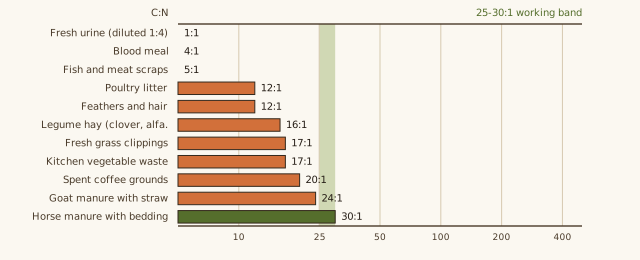
Every smell problem in this log came from the green side. Greens run from 4:1 to 24:1, they are 60-85 % water, and the strongest of them will clear a garden within a day if handled badly.
01Ratios at a glance
02The table
| # | material | C:N | water | N % | dose |
|---|---|---|---|---|---|
| 01 | Fresh urine (diluted 1:4)A legitimate starter for carbon-heavy piles. Do not apply within a month of harvesting raw leafy crops. | 1:1 | 99% | 1.10 | 4 L of dilution per 10 kg of dry browns; apply to the core, not the surface. |
| 02 | Blood mealFastest nitrogen available and the easiest to overdose; expect an ammonia smell for a day if you use too much. | 4:1 | 8% | 12.00 | 350 g per 30 kg of brown-heavy material; never more than 1 % of pile weight. |
| 03 | Fish and meat scrapsLegal in most places, but attracted animals are the limiting factor, not the composting. | 5:1 | 70% | 9.00 | Bury 25 cm deep in the core; never add to a tumbler or an open surface. |
| 04 | Poultry litterStrongest common manure. Never store it — the ammonia starts within hours. | 12:1 | 55% | 4.80 | 1 part litter to 1 part carbon by volume; mix the same day it is collected. |
| 05 | Feathers and hairVery high nitrogen but slow to break down; hair decomposes faster than feathers. | 12:1 | 12% | 4.00 | Up to 3 % of pile volume; chop hair, and expect feathers to take two seasons. |
| 06 | Legume hay (clover, alfalfa)The best dry green: high nitrogen without the moisture of fresh material. | 16:1 | 14% | 2.60 | 1 part hay to 2 parts straw by volume; excellent for heating a woody pile. |
| 07 | Fresh grass clippingsMats into an airless slab within 36 hours if layered thick; the classic cause of a sour pile. | 17:1 | 78% | 2.40 | Maximum 15 cm layers, always mixed with browns; 1 kg greens per 600 g cardboard. |
| 08 | Kitchen vegetable wasteVery wet and very attractive to rodents and flies; burial is not optional. | 17:1 | 80% | 2.30 | 1 kg per 1.5 kg of cardboard; bury in the core rather than surface-adding. |
| 09 | Spent coffee groundsA green despite the colour. Moulds and turns sour in storage after about five days. | 20:1 | 62% | 2.10 | 1 kg per 1.3 kg of cardboard; compost within five days of collection. |
| 10 | Goat manure with strawThe easiest manure to handle: pelleted, dry, and it starts heating on its own. | 24:1 | 40% | 1.90 | Use without a nitrogen subsidy; add browns at 1 part per 3 parts manure. |
| 11 | Horse manure with beddingIts C:N depends almost entirely on how much bedding is mixed in. | 30:1 | 62% | 1.60 | Use as a green-brown hybrid; ask which wormer was used before putting it on vegetable beds. |
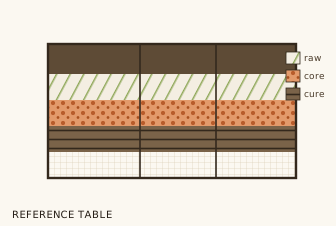
Nothing in the table is built on its own: this is where each class of material ends up once a bin is charged from it.
03How to use this table
- 01 Read the nitrogen percentage first, not the C:N — it tells you how fast the material acts.
- 02 Pre-mix strong greens into carbon on a tarp before they go into the pile.
- 03 Never place blood meal, poultry litter or fish waste on or near the surface.
- 04 Weigh strong greens; do not dose by volume or by eye.
- 05 Account for the water that wet greens bring before adding any from a hose.
- 06 Bury kitchen waste and fish waste at least 20-25 cm deep in the core.
- 07 If you smell ammonia, add carbon immediately; if you smell vinegar, add carbon and turn.
04The nitrogen percentage tells you the risk
C:N tells you the ratio; the nitrogen percentage tells you how fast the material will release it. Blood meal at 12 % and poultry litter at 4.8 % release nitrogen within hours of getting wet, which is why they smell strongly and why they can burn plants if used fresh. Grass at 2.4 % and kitchen waste at 2.3 % release it over days and are forgiving. The materials in the top half of this table should always be pre-mixed with carbon before they go anywhere near a bare heap.
05Moisture is where greens surprise you
Fresh grass at 78 % and kitchen waste at 80 % deliver most of their weight as water. Five kilograms of grass contributes 3.9 kg of water to the pile — which is why a green-heavy batch does not need watering at all, and why adding water to a pile that smells sour usually makes it worse. Greens are also the reason a pile built in a wet week can be at 70 % moisture with no water added by hand.
06The four strongest materials and how to use them
Blood meal, poultry litter, fish waste and urine are the four materials in this table that can ruin a batch by overdose. All four follow the same rule: mix into carbon, never place on or near the surface, and dose by weight. For a 100 kg pile of mixed browns, that means 350 g of blood meal, or 10 kg of poultry litter, or 5 L of urine diluted 1:4 — and in the case of fish waste, 25 cm of coverage above it, in the core, in a pile that will reach 55 °C.
07Using this table with the browns table
The two tables are designed to be used together. Take 10 kg of leaves at 50:1 and 10 kg of cardboard at 350:1 — that is 9.8 kg plus 10 kg of effective carbon, against 0.2 kg plus 0.03 kg of nitrogen, or roughly 100:1. To bring it to 30:1 you need about 0.66 kg of nitrogen, which is 27 kg of fresh grass, or 5.5 kg of poultry litter, or 55 L of diluted urine. The point of working it out once is that the answer is never 'a bit more grass'.
08Questions this batch raised
- Can I compost meat and fish in a home pile?
- Yes, if you bury it 25 cm deep in the core of a pile that reaches 55 °C, and if local regulations allow it. The composting is not the problem — the animals it attracts are. In an urban garden with rats, it is usually not worth it; a bokashi bucket handles meat indoors and produces a material you can then bury.
- Are coffee grounds a green?
- Yes, at 20:1 with 62 % moisture. The dark colour makes people treat them as a brown and then wonder why the pile will not heat. Use them 1:1.3 with cardboard by weight.
09Faults this batch illustrates
- Ammonia smellA sharp, cleaning-product smell at the vent or when the lid is opened, often strongest in the first week.
- Sour or rancid smellA vinegar, silage or rancid-butter smell, usually with a temperature drop of several degrees.
- Rodents digging in the pile or bedHoles in the side of a heap or in a mulched bed, and food waste visible on the surface.