Batch log · wire bay · posted 01 Sep 2026
Summer grass clippings balanced with corrugated cardboard
Nine mowings over eleven weeks, 780 g of nitrogen-rich clippings per mowing, and the two days the cage went sour because the grass went in wet and matted.
01The sheet
| material | kg in | C:N | water | role | carbon |
|---|---|---|---|---|---|
| Fresh grass clippings (un dried) | 7.0 | 17:1 | 78% | green | 6.6 |
| Corrugated cardboard (torn, 5 cm) | 4.2 | 350:1 | 9% | brown | 4.2 |
| Shredded office paper | 1.1 | 175:1 | 8% | brown | 1.1 |
| Wood ash (light dusting between layers) | 0.2 | 0:1 | 2% | balancer | — |
| Finished compost from the spring batch | 3.0 | 12:1 | 41% | balancer | 2.8 |
| Blended | 15.5 | 23:1 | 46% | 14.7 kg C-eq | |
02Batch facts
- Bin
- wire bay
- Charged
- 19 May 2026
- Finished
- 15 Aug 2026
- Thermal class
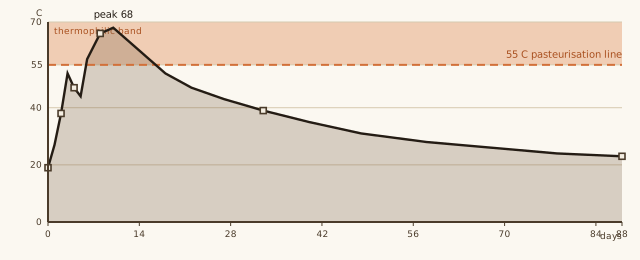
- Thermophilic (crossed 55 °C)
- Turns
- 7
- Days to finish
- 88
- Finished volume
- 210 L
- Target C:N
- 30:1 (as charged 23:1)
- Moisture at build
- 61 % (as charged 46 %)
- Odour risk
- medium
- Space needed
- A 1 m × 1 m × 1.1 m wire cage with a removable front panel; keep 60 cm clear on the turning side.
- Time to finish
- 88 days including a 3-week cure; the hot phase itself was 19 days.
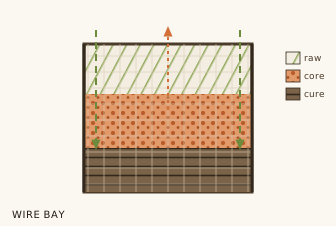
Drawn to the shape of this container and its working volume. Dashed arrows are airflow; hatching is the hot core that holds the temperature curve above.
03The 780 g rule for a 1 m cage
One square metre of lawn cut at 4 cm yields 700-900 g of clippings. That sounds small until you stack nine mowings into one cage: 7 kg of 78 % moisture grass, which shrinks to about 1.8 kg of dry matter and, if unbalanced, to an anaerobic slab 15 cm thick on the floor. The working rule here is 1 kg of clippings to 600 g of torn cardboard by weight — roughly one mowing's grass to two large delivery boxes.
04Why cardboard and not sawdust
Sawdust would also work at 350-500:1, but it is slow to wet and tends to form water-repellent pockets. Corrugated cardboard brings the same carbon with an open fluted structure that holds air, which is exactly what matted grass lacks. Torn to 5 cm rather than shredded to dust: the flakes support the pile and keep a chimney of air up the middle. Remove the tape and the glossy print layer — both survive composting for years.
05The day-4 souring, in detail
Day 3 hit 52 °C, day 4 dropped to 47 °C, and the front panel smelled of rancid butter. A 6 °C drop in the hot phase almost always means the airflow has collapsed or the moisture has gone over 70 %. In this case both: the grass layer had sealed the surface and a 2 cm water film sat in the bottom of the cage. The correction was a full outside-to-inside turn, 2 kg of dry cardboard worked through the core, and drilling ten 12 mm holes in the bottom of the front panel for drainage. Temperature recovered to 57 °C within 24 hours and peaked at 68 °C on day 10.
06Wood ash: small dose, real limits
200 g of ash across a 1 m³ batch raises potassium and lifts pH slightly, which helps if the pile is trending acidic from the clippings. It is not a substitute for carbon, and it should never exceed 1 kg per cubic metre — at that dose the pH can push past 8.5 and volatilise nitrogen as ammonia. Keep ash away from any pile that already smells of ammonia.
07Result after 88 days
210 L from a starting volume of roughly 430 L, so a shrink ratio of about 2:1 — normal for a grass-heavy batch with so much water to lose. Final C:N measured 15:1 by the lab kit, pH 7.4, and the compost went on as a 2 cm top dressing over the lawn it came from. Two surviving clumps of matted grass were found at screening and went back into the next batch.
08Turn schedule
- day 0 Build the cage in alternating 10 cm layers: grass, cardboard, grass, paper. Do not tread it down.
- day 2 First turn with a pitchfork, outside to inside. Break up every matted clump by hand.
- day 4 Sour smell detected; the fix was a full turn plus 2 kg of dry cardboard mixed through the core.
- day 8 Turn every 2 days through the hot phase; peak 68 °C on day 10.
- day 19 Last hot turn, then cover the cage with a breathable tarp for the cure.
- day 33 Turn once for aeration, water only if the core is dry below 40 % moisture.
- day 88 Screen at 10 mm and bag the finished 210 L.
09Temperature curve, as it ran
Smell notes
The day-4 sour smell is the signature failure of grass-heavy batches: clippings mat into an airless slab within about 36 hours of going in wet, and anaerobic bacteria produce butyric acid, which smells like rancid butter or vomit. It cleared within a day of turning and adding dry cardboard. The other smell to watch for is a sharp ammonia note — that means the carbon is too low, and the answer is more cardboard, not more water.
10Questions this batch raised
- Can I compost clippings if the lawn was treated with herbicide?
- Not safely for food beds. Clopyralid and aminopyralid survive composting and pass through into the compost, where they stunt tomatoes and legumes for two seasons. Grass from a treated lawn belongs in the green-waste collection, not on a compost heap, and the same restriction applies to manure from animals fed treated hay.
- Should I dry the clippings first?
- If you have the space, spread them 2 cm deep for a day — fresh clippings drop about 15 points of moisture in 24 hours in full sun, which makes them far easier to mix. If you cannot, add 50 % more cardboard by weight to compensate.
11Faults this batch illustrates
- Sour or rancid smellA vinegar, silage or rancid-butter smell, usually with a temperature drop of several degrees.
- Matted clumps that will not break upGrapefruit-sized or larger balls of material that survive turning and are soggy inside.
- The pile will not heatTemperature sits within 5 °C of ambient for a week or more. The material looks fine and does not smell.