Batch log · insulated bin · posted 20 Sep 2026
Office shred and delivery cardboard, 300 L insulated bin
Two months of office shreddings, 14 kg of delivery boxes and a nitrogen problem that had to be solved with 2.4 kg of grass, because paper alone will not heat.
01The sheet
| material | kg in | C:N | water | role | carbon |
|---|---|---|---|---|---|
| Office shreddings (mixed bond, staples removed) | 12.0 | 200:1 | 7% | brown | 11.9 |
| Corrugated delivery cardboard (torn) | 14.0 | 350:1 | 9% | brown | 14.0 |
| Grass clippings (dried 3 days) | 2.4 | 22:1 | 42% | green | 2.3 |
| Canteen vegetable trim (chopped) | 6.0 | 16:1 | 82% | green | 5.6 |
| Urine, diluted 1:4 (nitrogen starter) | 6.5 | 1:1 | 99% | balancer | 2.9 |
| Blended | 40.9 | 9:1 | 35% | 36.7 kg C-eq | |
02Batch facts
- Bin
- insulated bin
- Charged
- 27 Jun 2026
- Finished
- 01 Oct 2026
- Thermal class
- Thermophilic (crossed 55 °C)
- Turns
- 7
- Days to finish
- 96
- Finished volume
- 180 L
- Target C:N
- 30:1 (as charged 9:1)
- Moisture at build
- 52 % (as charged 35 %)
- Odour risk
- low
- Space needed
- One 300 L insulated plastic bin with a lid, in partial shade.
- Time to finish
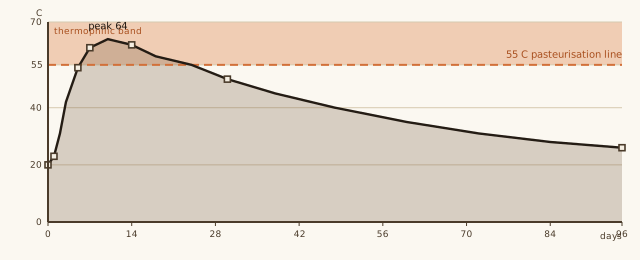
- 96 days, of which the first 24 were above 55 °C.
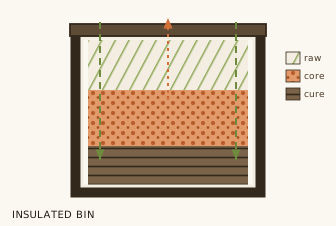
Drawn to the shape of this container and its working volume. Dashed arrows are airflow; hatching is the hot core that holds the temperature curve above.
03Why paper needs a nitrogen subsidy
Office shreddings sit around 200:1 and corrugated cardboard around 350:1. Twenty-six kilograms of that mix contains roughly 108,000 g of carbon and 385 g of nitrogen — a ratio near 280:1, which no compost heap will digest at a useful speed. The 2.4 kg of dried grass plus 6 kg of canteen trim adds 740 g of nitrogen, and the 6.5 kg of diluted urine adds another 205 g, bringing the working ratio down to about 108,000 g C against 1,330 g N, or 81:1. That is still on the high side for a fast hot pile, which is why this batch ran 96 days rather than 60.
04The 30-minute soak
Dry cardboard is engineered to resist water. A flattened box dunked briefly and pulled out can be dry in the flutes a week later, and that dry flue is exactly where the pile goes cold in a stripe. Thirty minutes fully submerged in a wheelbarrow, then left to drain until it stops dripping, is the difference between a batch that heats evenly and one that has three cold zones at screening.
05Urine as a starter, and the limits
Diluted urine at 1:4 is a legitimate nitrogen source, roughly 0.8:1 in carbon terms, and 6.5 kg of the dilution contributes about 11 g of nitrogen per litre of urine — the same order as a commercial liquid feed. Two constraints: do not use it on a pile that is already smelling of ammonia, and do not apply it within a month of harvest on leafy crops used raw, for hygiene rather than composting reasons.
06Insulation pays for itself in winter, not summer
The insulated bin was chosen for its ability to hold heat overnight, and in this June-to-September run that mattered less than expected: ambient temperatures were already 24-30 °C. The measured benefit was a slower overnight drop, 3-5 °C rather than 8-10 °C in a bare plastic bin, which keeps the pile inside the thermophilic band for a longer daily window. The same bin run through a November start would need 40 L of straw bales stacked around it to reach the same place.
07Output
180 L of screened compost from about 41 kg of inputs, and a noticeably finer texture than the leaf batch: paper compost screens to a floury consistency and is excellent for potting mixes at 25-30 % by volume. Nitrogen analysis was low at 0.6 % total, so treat it as a texture and moisture amendment rather than a feed.
08Turn schedule
- day 0 Soak the cardboard in a wheelbarrow of water for 30 minutes before it goes in — dry cardboard will not wet inside the bin.
- day 1 Pour the diluted urine over the top, close the lid and leave the bin alone for 48 hours.
- day 5 First turn; the shreddings and cardboard should now be uniformly damp but not dripping.
- day 7 Turn and check the core temperature; 61 °C means the mix is working.
- day 14 Turn. Add 1 L of water down the centre if the core has dropped below 45 % moisture.
- day 30 Turn weekly from here. The paper fraction collapses fast once the heat passes.
- day 96 Screen at 10 mm. Paper batches screen cleanly; expect almost no oversize.
09Temperature curve, as it ran
Smell notes
There was almost nothing to smell for the first four days, which is exactly the problem with paper batches: no smell is often no activity. The canteen trim produced a faint cooked-cabbage note around day 6 that disappeared after the turn on day 7. Nothing sour, nothing ammoniacal. The one real risk with paper is a dry, dusty pile that never heats, and the 30-minute soak plus the liquid inputs are what prevent it.
10Questions this batch raised
- Is printed and glossy paper safe to compost?
- Standard newspaper and office paper use soy or water-based inks and are fine. Glossy magazine stock and thermal till receipts are not: the coating slows breakdown and thermal paper carries bisphenol A or S, which you do not want in soil used for food. Remove the glossy inserts before the boxes go in.
- My paper pile smells of nothing and sits at 25 °C. What now?
- Add nitrogen and water together — 1 kg of grass or 4 L of diluted urine, then turn. A carbon-only pile will sit indefinitely; the fix always needs both inputs at once, not one at a time.
11Faults this batch illustrates
- The pile will not heatTemperature sits within 5 °C of ambient for a week or more. The material looks fine and does not smell.
- Pile is dry and crumblyThe material crumbles rather than clumps, the surface looks dusty, and the temperature is below 40 °C.
- Cold zones found at screeningUndigested material with original colour and structure appears at screening, usually from one side of the pile.