Method · in-situ bed · posted 22 Oct 2026
Sheet mulching: composting in place instead of in a bin
Sometimes the right place to put 80 kg of compostable material is not a bin at all. A sheet-mulched bed converts lawn into growing space in one afternoon, using the same carbon and nitrogen rules in a flat rather than a heap.
01The sheet
| material | kg in | C:N | water | role | carbon |
|---|---|---|---|---|---|
| Corrugated cardboard (sheet, all tape removed) | 12.0 | 350:1 | 8% | brown | 12.0 |
| Composted manure (the nitrogen layer) | 25.0 | 20:1 | 45% | green | 23.8 |
| Autumn leaves | 20.0 | 50:1 | 25% | brown | 19.6 |
| Garden compost (top layer) | 23.0 | 14:1 | 44% | balancer | 21.5 |
| Blended | 80.0 | 24:1 | 34% | 76.8 kg C-eq | |
02Batch facts
- Bin
- in-situ bed
- Thermal class
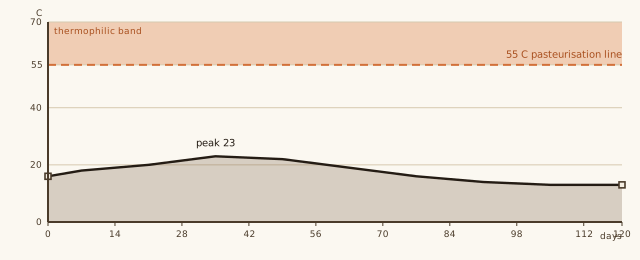
- Mesophilic (stayed below 55 °C)
- Turns
- 6
- Days to finish
- 120
- Target C:N
- 40:1 (as charged 24:1)
- Moisture at build
- 60 % (as charged 34 %)
- Odour risk
- low
- Space needed
- The bed itself — 4 m² per sheet-mulched bed, with 20 kg of material per square metre.
- Time to finish
- 120 days from laying to planting, or 180 for a bed built over established grass.
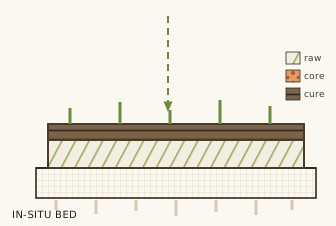
Drawn to the shape of this container and its working volume. Dashed arrows are airflow; hatching is the hot core that holds the temperature curve above.
03Why cardboard and not landscape fabric
Woven landscape fabric is designed not to break down, which means it stays in the soil as a barrier to roots, worms and water movement, and has to be removed by hand later. Corrugated cardboard does the same smothering job for 8-14 weeks and then becomes food for the soil food web. The requirement is to remove every piece of tape and every glossy label, because plastic tape survives both the composting and the following two seasons.
04The flat version of the C:N problem
The same ratios apply, but the constraint is different: in a heap, everything is mixed, while in a sheet-mulched bed the layers sit on top of each other and interact only at their boundaries. That is why the nitrogen layer goes directly under the leaf layer and above the cardboard — the grass dying beneath the cardboard supplies nitrogen from below, the manure supplies it from above, and the leaves in the middle are the reservoir. Get the order wrong, with 20 cm of leaves on top of bare cardboard and no nitrogen anywhere, and the bed will sit inert for a year.
05What it does to the soil below
Under a sheet-mulched bed the soil is not disturbed, which is most of the point: fungal networks, worm burrows and soil structure all survive. Measurements on the beds here after one season showed earthworm counts of 14 per spade against 4 on the adjacent tilled bed, and infiltration of a 20 L watering can faster than on the untilled control. The trade is that the soil under the cardboard stays cooler and wetter for the first six weeks, which slows spring planting — sheet mulch in autumn, not in April.
06Building it in the right season
Autumn is the only sensible time. Laid in October, the bed has six months of mild, wet weather to break down the cardboard and start the layers before spring planting; laid in April it delays planting by two months and by then the leaves have dried on the surface. The 120-day figure in this log is for an autumn build; a spring build over established grass realistically needs 180 days before the first transplant goes in.
07Turn schedule
- day 0 Cut the grass as short as possible and leave the clippings in place; do not dig or strip the turf.
- day 0 Lay overlapping cardboard, 15 cm of overlap at every seam, and water it until it is soaked through.
- day 0 Build the bed in three flat layers: manure 5 cm, leaves 10 cm, garden compost 5 cm.
- day 30 Check the seams for grass pushing through. Any breakthrough gets another sheet of cardboard on top.
- day 60 Pull any perennial weed roots that have survived at the edges; do not disturb the bed surface.
- day 120 Plant through the surface: make a hole, add a handful of compost, and set the transplant directly into the cardboard layer below.
08Temperature curve, as it ran
Smell notes
A sheet-mulched bed smells of wet cardboard for the first week and then nothing. The failure to watch for is not smell but rodents: a bed that has kitchen waste in it, laid on the surface rather than in a bin, will attract rats. Everything in this method goes down as a layer with at least 5 cm of material above it, and food waste is the one input that does not belong here at all.
09Questions this batch raised
- Do I need to remove the turf first?
- No, and you should not — the turf is the nitrogen source for everything above it. Cut it short, leave the clippings, and lay cardboard directly on top. Only remove turf if it is dominated by a rhizomatous weed like couch grass or ground elder, in which case dig it out and put it in a black plastic bag in the sun for a season.
- How long does the cardboard take to disappear?
- Eight to fourteen weeks under wet conditions, longer in a dry summer. It does not need to disappear before you plant: transplants go into a hole cut through it, and the cardboard continues to suppress grass around them for another month. Seeds sown on the surface will not germinate through it — use transplants for the first season.
10Faults this batch illustrates
- Grass through the cardboard seamsTufts of grass pushing up through the joins in a sheet-mulched bed within four to six weeks.
- Plants yellowing after compost or chip mulchPale, yellowing lower leaves and stalled growth within two to four weeks of applying wood-based compost or digging in…
- Rodents digging in the pile or bedHoles in the side of a heap or in a mulched bed, and food waste visible on the surface.