Batch log · wire bay · posted 26 Oct 2026
Hedge trimmings, chipped, and left for eight months
Not everything in a compost bay is trying to be a hot pile. 300 L of chipped privet and hawthorn took 240 days and produced the best mulch in the garden.
01The sheet
| material | kg in | C:N | water | role | carbon |
|---|---|---|---|---|---|
| Chipped hedge trimmings (privet, hawthorn, 30 mm) | 150.0 | 60:1 | 32% | brown | 147.5 |
| Grass clippings (nitrogen subsidy) | 9.0 | 17:1 | 76% | green | 8.5 |
| Kitchen scraps (buried in the core) | 26.0 | 18:1 | 78% | green | 24.6 |
| Soil from the bed being cleared | 15.0 | 12:1 | 22% | balancer | 13.8 |
| Blended | 200.0 | 35:1 | 39% | 194.5 kg C-eq | |
02Batch facts
- Bin
- wire bay
- Charged
- 30 May 2026
- Finished
- 25 Jan 2027
- Thermal class
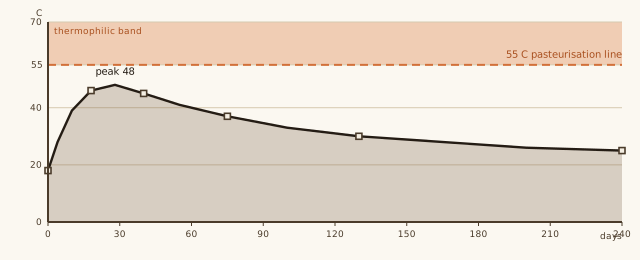
- Mesophilic (stayed below 55 °C)
- Turns
- 6
- Days to finish
- 240
- Finished volume
- 300 L
- Target C:N
- 40:1 (as charged 35:1)
- Moisture at build
- 46 % (as charged 39 %)
- Odour risk
- low
- Space needed
- Two wire bays 1.2 m across; chipped hedge needs 8 months and the bays must stay in place that long.
- Time to finish
- 240 days. Wood chips are the slowest material in this log and there is no way to hurry them.
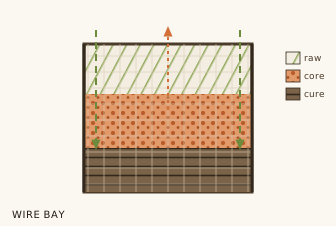
Drawn to the shape of this container and its working volume. Dashed arrows are airflow; hatching is the hot core that holds the temperature curve above.
03Why wood chips do not get hot
Chipped hedge is 45-70:1 and 30 % moisture, and its surface is largely lignin and resin — the parts of a plant designed to resist microbial attack. The nitrogen is locked inside the woody fraction rather than on the surface where bacteria can reach it. In this batch the 26 kg of kitchen scraps and 9 kg of grass raised nitrogen enough to reach 48 °C, which is where the pile stayed for about six weeks. Wood chips will not go to 60 °C without unrealistically large nitrogen additions.
04The mulch case for chip piles
Screened at 240 days, this material is not a seedling-friendly compost — it still has visible chip structure and would immobilise nitrogen if dug in. As a top mulch it is the best thing in this log: 5-7 cm of it suppressed annual weeds for two seasons, held soil moisture through a dry August, and fed the soil food web from below. Keep it out of the soil and on top of it.
05The nitrogen robbery question
The old warning that wood chips rob nitrogen from soil is true only when they are dug in. Applied on the surface, the zone of nitrogen immobilisation is limited to the millimetres of soil in direct contact with the chip, and earthworms gradually move both chip fragments and their casts downward. On a bed mulched with this material in June, soil nitrate at 5 cm measured 8 mg/kg in September against 22 mg/kg on the unmulched control — a real but temporary and purely surface effect.
06240 days, told honestly
There is no shortcut here. Composting wood chips faster requires either a shredder fine enough to make sawdust, or nitrogen inputs of the order of 20 kg of manure per 150 kg of chips. The realistic options are: accept eight months, or use the chips as mulch directly and compost nothing. Where a chip pile does earn its place is as the brown fraction of a hot pile, and as the cover material for food waste in a small garden.
07Turn schedule
- day 0 Chip on the day of cutting; hedge trimmings left in a heap for a week first go mouldy and slimy.
- day 18 First turn, watering 30 L through the core. Peak 48 °C on day 28 — this is a warm pile, not a hot one.
- day 40 Turn and bury the first 13 kg of kitchen scraps in the core; the chips hide the smell completely.
- day 75 Turn, bury the second batch of scraps, water 20 L.
- day 130 Turn. Do not expect heat any more; the goal from here is even moisture.
- day 240 Screen at 20 mm: 300 L of dark, crumbly mulch, and 80 L of chips that went back for another year.
08Temperature curve, as it ran
Smell notes
Chipped hedge has almost no smell of its own and, usefully, absorbs the smell of other things. The 26 kg of kitchen scraps buried at day 40 and day 75 produced no detectable odour from the surface, which is why a chip pile is a legitimate way to compost food waste in a small garden. What you do smell is the difference between fresh chips (a sharp green-resin note, almost like turpentine on hawthorn) and finished mulch, which smells of forest floor.
09Questions this batch raised
- Should I compost hedge trimmings or chip them as mulch?
- Both, depending on quantity. Up to about 200 L a year is most useful as mulch straight away, particularly around shrubs. Above that, run a chip bay alongside the mulch pile — the screened output at 8 months is a finer, darker material than fresh chips and is better for vegetable beds.
- Can I compost conifer and leylandii trimmings?
- Yes, in a chip bay rather than a hot pile. Conifer material is acidic and resinous and will slow a hot pile if it makes up more than about 15 % of the volume. On its own, chipped conifer takes 12-18 months and makes an excellent mulch for acid-loving plants.
10Faults this batch illustrates
- The pile will not heatTemperature sits within 5 °C of ambient for a week or more. The material looks fine and does not smell.
- Pile is dry and crumblyThe material crumbles rather than clumps, the surface looks dusty, and the temperature is below 40 °C.
- Plants yellowing after compost or chip mulchPale, yellowing lower leaves and stalled growth within two to four weeks of applying wood-based compost or digging in…