Batch log · insulated bin · posted 28 Sep 2026
Poultry litter and sawdust through a January cold snap
Six hens, 60 kg of litter, minus 9 °C nights, and the reason a poultry pile needs to be built in one single day rather than accumulated over a month.
01The sheet
| material | kg in | C:N | water | role | carbon |
|---|---|---|---|---|---|
| Poultry litter (droppings + wood shavings) | 60.0 | 12:1 | 55% | green | 55.4 |
| Sawdust (kiln dried, softwood) | 16.0 | 450:1 | 10% | brown | 16.0 |
| Shredded autumn leaves | 9.0 | 52:1 | 24% | brown | 8.8 |
| Straw (chopped to 8 cm) | 5.0 | 80:1 | 13% | brown | 4.9 |
| Hot water (first charge only) | 14.0 | 0:1 | 100% | balancer | — |
| Blended | 104.0 | 17:1 | 49% | 85.1 kg C-eq | |
02Batch facts
- Bin
- insulated bin
- Charged
- 11 Jan 2026
- Finished
- 08 Jun 2026
- Thermal class
- Thermophilic (crossed 55 °C)
- Turns
- 7
- Days to finish
- 148
- Finished volume
- 120 L
- Target C:N
- 25:1 (as charged 17:1)
- Moisture at build
- 56 % (as charged 49 %)
- Odour risk
- high
- Space needed
- One 200 L insulated bin against a south-facing wall, plus straw bales for the sides in January.
- Time to finish
- 148 days — a January start means the first three weeks are spent just holding above 20 °C.
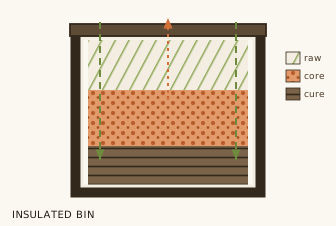
Drawn to the shape of this container and its working volume. Dashed arrows are airflow; hatching is the hot core that holds the temperature curve above.
03Build it in one day, not one month
The instinct with poultry litter is to add a bucket a day as the coop is cleaned. That gives you a thin, cold, ammoniacal layer that never heats and smells continuously. Sixty kilograms in a single afternoon, dosed with 30 kg of carbon in one go, gives a 200 L charge that will hold 40 °C through a frost. If you cannot collect 60 kg at once, store the litter in sealed bags for up to two weeks and build the pile in one pass when you have enough.
04The nitrogen numbers
Fresh poultry litter is 4-6 % nitrogen, which is three to four times horse manure. At 12:1, the 60 kg charge carries about 26,000 g of carbon and 2,170 g of nitrogen. The 30 kg of carbon amendments at an average of 190:1 add 28,000 g of carbon and 150 g of nitrogen, for a working ratio of 54,000:2,320, or 23:1 — close to the 25:1 target and deliberately conservative, because a poultry pile that runs too hot will strip nitrogen as ammonia gas rather than storing it.
05Cold-weather mechanics
A compost pile does not fail in cold weather; it fails to start. Microbial activity roughly halves for every 10 °C drop, so a pile at 4 °C ambient needs a much bigger initial mass to reach the thermophilic band. Three things made this January build work: 45 °C water as the initial charge (14 L, mixed through rather than poured on top), an insulated bin rather than a wire bay, and straw bales against all four sides. Without the bales the measured overnight loss was 6-8 °C; with them it was 2-3 °C.
06Why poultry compost goes on fruit, not legumes
Analysed at 2.8 % total nitrogen, 2.4 % phosphorus and 1.9 % potassium, this is a strong, unbalanced amendment. Phosphorus at that level suppresses mycorrhizal associations on legumes and can lock up iron in alkaline soils. Applied at 2 L/m² under fruit trees and currants it is excellent; on a bean bed it will produce leaf and no pods. Keep it away from acid-loving plants too — the pH of this compost was 7.9.
07The 148-day timeline
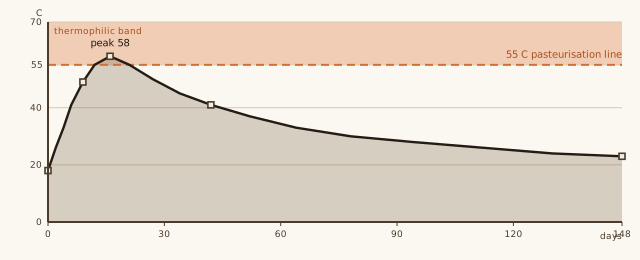
The slow part was the ramp: 12 days to reach 55 °C in January against 5-6 days for the same mix built in June. Once hot, the batch behaved normally, crossing the 55 °C threshold for six days. From day 42 the pile dropped out of thermophilic range and spent 15 weeks curing through a wet spring, which is longer than the manure batch needed because the sawdust fraction is finely divided and slow to break down completely.
08Turn schedule
- day 0 Build the whole bin in one afternoon. Mix 60 kg of litter with 16 kg of sawdust in three passes on a tarp before anything goes in.
- day 0 Charge with 14 L of hot water at 45 °C, which is the only reason a January pile starts at all.
- day 3 First turn. Core reads 26 °C; pile the straw bales around the bin on all four sides.
- day 9 Turn. Pile has crossed 45 °C and the ammonia smell has gone.
- day 16 Turn and seal the lid; peak was 58 °C on day 16.
- day 42 Remove the straw bales, turn, and let the pile ride down through spring.
- day 148 Screen at 10 mm. The finished litter compost is high in phosphorus — keep it off beans and clover.
09Temperature curve, as it ran
Smell notes
Poultry litter is the strongest-smelling material in this whole log, at 12:1 and 4-6 % nitrogen. Straight from the coop it will clear a garden. The trick is not to store it: mix it with sawdust the same day it comes out, and the ammonia smell goes within about four hours because the carbon binds the free nitrogen. The one failure in this batch was day 2, when the bin was turned but the mix had not been re-wetted and a sharp ammonia edge came back until the hot water went in.
10Questions this batch raised
- Can I compost poultry litter with the bedding still in it?
- Yes, and you should — the wood shavings are already part of the carbon balance. Just weigh or estimate the litter-to-shaving ratio; if the coop smells strongly of ammonia, it is running nitrogen-heavy and needs additional sawdust or leaves at roughly 1 kg of carbon per 2 kg of litter.
- Do I need to worry about pathogens?
- Poultry litter can carry Salmonella and E. coli. Six consecutive days above 55 °C, turning included so no material stays on the cold outer edge, is the standard that makes it safe for garden use, followed by at least four months of cure before it goes near a food crop. Wash hands and tools afterwards.
11Faults this batch illustrates
- Ammonia smellA sharp, cleaning-product smell at the vent or when the lid is opened, often strongest in the first week.
- The pile will not heatTemperature sits within 5 °C of ambient for a week or more. The material looks fine and does not smell.
- Winter pile never startsA pile built in November or December sits at 10-15 °C for six weeks or more.