Batch log · pallet bin · posted 07 Sep 2026
Horse manure and straw bedding, two pallet bins
A full winter's bedding from one stable box, 340 L of finished compost, and the anthelmintic question that decides whether it can go on a vegetable bed.
01The sheet
| material | kg in | C:N | water | role | carbon |
|---|---|---|---|---|---|
| Horse manure with straw bedding | 96.0 | 30:1 | 62% | green | 92.9 |
| Wheat straw (loose, from a broken bale) | 18.0 | 80:1 | 14% | brown | 17.8 |
| Shredded paper bedding (pelleted) | 9.0 | 175:1 | 10% | brown | 8.9 |
| Garden soil (inoculant, 3 spadefuls) | 6.0 | 10:1 | 25% | balancer | 5.5 |
| Blended | 129.0 | 32:1 | 50% | 125.1 kg C-eq | |
02Batch facts
- Bin
- pallet bin
- Charged
- 04 Apr 2026
- Finished
- 14 Aug 2026
- Thermal class
- Thermophilic (crossed 55 °C)
- Turns
- 7
- Days to finish
- 132
- Finished volume
- 340 L
- Target C:N
- 26:1 (as charged 32:1)
- Moisture at build
- 58 % (as charged 50 %)
- Odour risk
- medium
- Space needed
- Two 1.2 m × 1.2 m pallet bins side by side, plus a tarp for the cure stage.
- Time to finish
- 132 days — manure batches run hot for three weeks and then cure slowly because of the bedding volume.
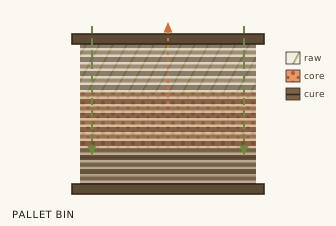
Drawn to the shape of this container and its working volume. Dashed arrows are airflow; hatching is the hot core that holds the temperature curve above.
03Manure is a green, not a brown
The single most common error with horse manure is treating it as a carbon source. Straight horse manure runs 25-35:1 only because of the bedding mixed into it; the dung itself is closer to 15:1. In this batch the 96 kg of manure and bedding averaged 30:1, which is high enough that the pile still needed a nitrogen push — hence the 6 kg of garden soil and the decision to start the bin in April, when ambient warmth helps the first week.
04Why the batch runs 132 days
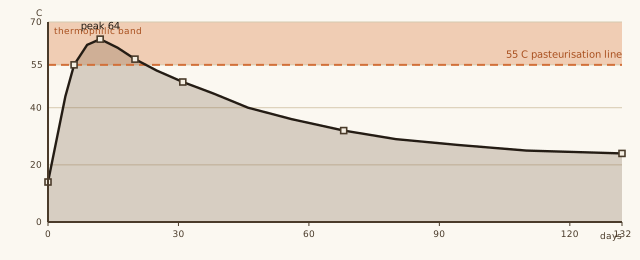
The straw in the bedding is the slow fraction. Straw is 60-80:1 with a lignified stem that resists breakdown until the surrounding material has been through one heating cycle. The temperature curve shows this clearly: 3 weeks above 55 °C while the manure fraction goes, then a long, flat decline from 49 °C at day 31 to 27 °C at day 94 while the straw catches up. Screening at 132 days still returns about 12 % oversize straw. Leaving manure batches for four months is not laziness; it is the only way to get straw through the mesh.
05The anthelmintic question
Ivermectin and moxidectin residues in manure can persist for weeks to months and are toxic to dung beetles and some soil invertebrates. The practical rule: ask the yard which wormer was used and when. Moxidectin has the longest persistence — keep that manure out of the vegetable beds and put it on ornamentals or leave the finished compost for a full year before use. This batch came from a yard using a fenbendazole-based wormer administered in February, so the last dose was 7 weeks before the manure was collected and the compost was held 132 days after that.
06Two bins, not one
Two 1.2 m bins in a row is the minimum workable setup: you need somewhere to turn into, and turning by hand into the same bin means the bottom never gets to the top. The layout here is bin 1 filling, bin 2 working, and a tarped heap for the cure stage. The turn on day 6 is genuinely heavy work; a fork with a 1.1 m handle rather than a short digging fork saves your back on a 96 kg charge.
07Yield and use
96 kg plus 33 kg of dry amendments produced 340 L of screened compost, roughly 190 kg at 45 % moisture, so the mass loss was about 60 % — most of it water and carbon dioxide in the first month. Analysis came back at 1.9 % total nitrogen, pH 8.1 (manure compost is alkaline; do not add ash), and 34 % organic matter. It was applied at 4 L/m² to a squash bed and used as the top layer of a raised bed mix at 1:1:1 with sieved topsoil and leaf mould.
08Turn schedule
- day 0 Fill bin 1 to 1 m depth in one go; do not layer, manure bedding is already mixed at the stable.
- day 6 First turn, bin 1 into bin 2. This is the heaviest job in the whole schedule — 96 kg of wet material.
- day 12 Turn back into bin 1. Peak heat 64 °C on day 12.
- day 20 Turn. Ammonia smell by now gone; the pile smells of mushrooms.
- day 31 Turn, then leave undisturbed for a month to let the straw fraction break down.
- day 68 Turn and cover with a tarp to hold moisture through the cure.
- day 132 Screen at 12 mm; the straw that survives goes back into the next winter's bedding.
09Temperature curve, as it ran
Smell notes
Fresh manure bedding smells of ammonia for the first three days because the urea is hydrolysing faster than the pile can heat. By day 6 the smell had turned to a mild mushroom note and stayed there. The failure mode for manure is different from grass: it is not souring but saturation. If the pile hisses when you push a fork in, or water pools in the fork holes, the bedding was too wet when it left the stable and needs another 5 kg of loose straw per turn.
10Questions this batch raised
- Does horse manure need to be aged before use?
- Yes, always. Fresh manure at 15:1 will burn seedlings and carries viable weed seeds from the hay. Three weeks of hot composting above 55 °C plus a cure is the minimum; a full 4 months when the bedding is straw-heavy, as here.
- Can I compost manure in winter?
- You can start a bin in winter, but expect a 6-10 week delay before it heats. A 1 m³ charge of fresh manure bedding will hold 30-40 °C through a mild winter from its own biological activity and will take off properly in spring. Insulate the sides with straw bales if you want it to keep working.
11Faults this batch illustrates
- Ammonia smellA sharp, cleaning-product smell at the vent or when the lid is opened, often strongest in the first week.
- Water pooling in the binLiquid visible at the bottom of the bin or in the fork holes, and the lower material is slimy.
- The pile will not heatTemperature sits within 5 °C of ambient for a week or more. The material looks fine and does not smell.