Batch log · pallet bin · posted 12 Oct 2026
Spent mushroom substrate, straight from a commercial grower
120 kg of spent oyster-mushroom blocks, already white with mycelium, and why the single most important step is breaking the blocks apart on the day they arrive.
01The sheet
| material | kg in | C:N | water | role | carbon |
|---|---|---|---|---|---|
| Spent oyster substrate (straw + sawdust block) | 120.0 | 38:1 | 68% | green | 116.9 |
| Straw (chopped, to open the blocks) | 12.0 | 80:1 | 13% | brown | 11.9 |
| Wood chip (10 mm, from prunings) | 8.0 | 300:1 | 20% | brown | 8.0 |
| Hen manure pellets (nitrogen lift) | 2.5 | 8:1 | 12% | balancer | 2.2 |
| Blended | 142.5 | 39:1 | 60% | 139.0 kg C-eq | |
02Batch facts
- Bin
- pallet bin
- Charged
- 22 Apr 2026
- Finished
- 17 Jul 2026
- Thermal class
- Thermophilic (crossed 55 °C)
- Turns
- 6
- Days to finish
- 86
- Finished volume
- 240 L
- Target C:N
- 32:1 (as charged 39:1)
- Moisture at build
- 64 % (as charged 60 %)
- Odour risk
- low
- Space needed
- One pallet bin and a tarp; the substrate arrives in 20 kg blocks that need breaking up by hand.
- Time to finish
- 86 days, and it goes hot within 48 hours because the substrate is already inoculated.
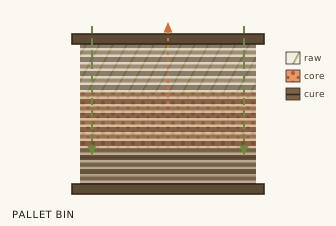
Drawn to the shape of this container and its working volume. Dashed arrows are airflow; hatching is the hot core that holds the temperature curve above.
03What is actually in spent substrate
A commercial oyster-mushroom block is straw and hardwood sawdust, roughly 60:40, plus a small amount of gypsum. After two flushes the fungus has eaten the easy sugars and left the lignin; measured C:N comes out at 35-40:1, higher than the raw mix because the nitrogen has been consumed. That is why this batch needed 2.5 kg of hen manure pellets: without a nitrogen lift a substrate pile heats to about 40 °C and stops.
04The 48-hour head start
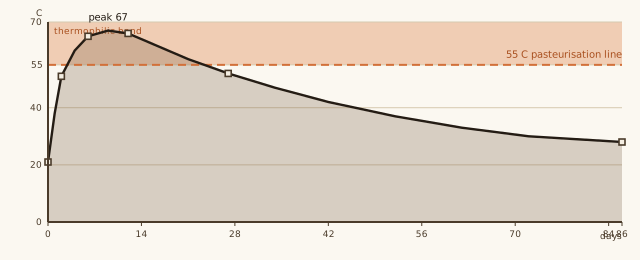
The pile hit 51 °C on day 2 without any starter culture, because the substrate arrives colonised by a live fungus and a bacterial community adapted to it. That head start also means the pile can overheat faster than expected — 67 °C by day 9 is a full week ahead of an equivalent straw batch. Watch it daily for the first week rather than the usual every-other-day.
05Water is the real constraint
At 68 % moisture the substrate is already at the top of the workable range, and additional water will only push it anaerobic. The correct handling is to add dry materials — straw and wood chip, 20 kg in this batch — and to let them soak up the excess. By day 12 the moisture had fallen to 64 %; by day 40, to 52 %. Screening happened at 47 %, which is why the output is light and crumbly rather than dense.
06Yield and one caution
120 kg of substrate plus 22.5 kg of dry amendments yielded 240 L of compost, and the volume loss was substantial because the blocks were mostly water. Analysis: total nitrogen 1.1 %, pH 7.2, low in phosphorus. The caution is gypsum. Substrate blocks contain added calcium sulfate, and while it is a useful source of calcium and sulfur at normal rates, compost made entirely from substrate and applied repeatedly to the same beds will accumulate salts. Rotate it across beds rather than putting it all on one.
07Turn schedule
- day 0 Break every block apart with a fork on a tarp; a block left whole will sit in the pile as an anaerobic brick.
- day 2 First turn, mixing in half the straw. Core already at 51 °C — the substrate comes pre-inoculated.
- day 6 Turn, add the wood chip and 2.5 kg of hen manure pellets. Peak 67 °C on day 9.
- day 12 Turn. This is the wettest batch in the log; squeeze test gives a strong sheen and a slow drip.
- day 27 Turn, then leave to cure. Do not add water — the batch is still at 62 %.
- day 86 Screen at 12 mm; the straw that survives is short and brittle and goes back as the next batch's brown.
08Temperature curve, as it ran
Smell notes
Spent substrate smells like a mushroom farm: mushroom, damp straw, a little like a cellar. Mixed and aerated, it stays that way. The failure mode is compaction — a whole block at the bottom of a bin turns to a grey, sour, slimy brick within a week, and once one forms the pile will not heat evenly again until you dig it out. Turning at day 2 and day 6 was mostly about hunting for blocks that had survived the initial break-up.
09Questions this batch raised
- Do I need to worry about mushroom spores or contamination?
- No. Oyster and button mushrooms are not plant pathogens and the fungus dies above 55 °C, which this pile exceeded for nine days. The only real caution is for anyone with a mushroom allergy working with a large volume of fresh substrate — wear a mask when breaking up dry blocks.
- Can I use spent substrate as a mulch without composting it?
- Yes, it is a perfectly good surface mulch at 5 cm, and the mycelium will continue to break it down in place. Do not dig it in fresh at more than 10 % by volume — it will rob nitrogen from the roots while it decomposes.
10Faults this batch illustrates
- Whole blocks compacted at the bottomA grey, sour, slimy brick of material found at the base of the bin when it is emptied, with a distinct boundary…
- Sour or rancid smellA vinegar, silage or rancid-butter smell, usually with a temperature drop of several degrees.
- Pile runs above 70 °CCore readings above 70 °C, a sharp smell of scorching, and visible white ash-grey microbial bloom.