Batch log · windrow · posted 05 Oct 2026
A 6 m windrow of municipal green waste, turned four times
What happens when you compost at the scale of a small van load: 1,400 L of output, a 78 °C peak, and the outer shell problem that costs you 15 % of the pile if you ignore it.
01The sheet
| material | kg in | C:N | water | role | carbon |
|---|---|---|---|---|---|
| Mixed green waste (grass, hedge, leaves) | 420.0 | 34:1 | 58% | green | 408.0 |
| Bark chips (screening oversize, returned) | 90.0 | 180:1 | 22% | brown | 89.5 |
| Woody prunings (chipped to 40 mm) | 60.0 | 300:1 | 18% | brown | 59.8 |
| Screened compost (inoculant, 40 L) | 22.0 | 14:1 | 44% | balancer | 20.5 |
| Blended | 592.0 | 41:1 | 48% | 577.8 kg C-eq | |
02Batch facts
- Bin
- windrow
- Charged
- 15 Mar 2026
- Finished
- 03 Jul 2026
- Thermal class
- Thermophilic (crossed 55 °C)
- Turns
- 6
- Days to finish
- 110
- Finished volume
- 1400 L
- Target C:N
- 30:1 (as charged 41:1)
- Moisture at build
- 50 % (as charged 48 %)
- Odour risk
- low
- Space needed
- A 6 m × 1.6 m × 1.1 m windrow on bare ground, with 2 m of turning space along one side.
- Time to finish
- 110 days, with four turns; a windrow this size holds heat far longer than a bin.
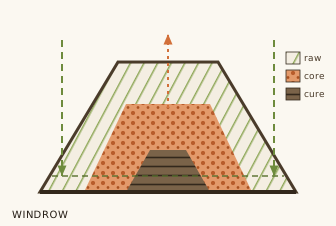
Drawn to the shape of this container and its working volume. Dashed arrows are airflow; hatching is the hot core that holds the temperature curve above.
03The outer shell costs you a fifth of the pile
In a bin, the dry edge is a few centimetres and the walls scrape it back in on every turn. In a 1.6 m wide windrow, the dry shell is 20-30 cm thick on the sunny side and it never heats. On this pile the shell accounted for roughly 15 % of the volume at screening — 210 L of material that had to go back into the next windrow rather than out as finished compost. Turning with a bucket so the shell becomes the new core is the whole technique; there is nothing else to it.
04Why the peak ran to 78 °C
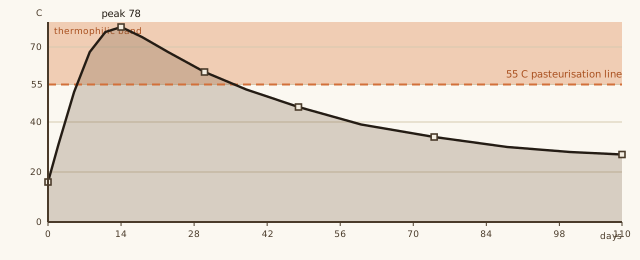
Small piles self-limit: heat escapes faster than it is generated above about 65 °C. A 6 m windrow with 4 m³ of material has enough insulation in its own mass to overshoot. 78 °C is above the point where the most useful thermophilic bacteria start to die off, and above 70 °C you begin to lose nitrogen as ammonia and to char the carbon you paid to put in. The correction at this scale is a turn at the 70 °C mark rather than waiting for the schedule — the day-14 turn was called two days early for exactly that reason.
05Water at scale is a different problem
A bin loses 2-3 L a week; this windrow lost about 200 L over 110 days, most of it in the first month when the surface area is largest relative to volume. Hose feeding is useless at 4 m³ — the water beads off the dry shell. What worked was adding 80 L directly onto the new core as it was rebuilt by the bucket, plus leaving the top slightly dished so rain collects rather than runs off. The old composters' rule of thumb — one litre per 10 kg in dry weather — held reasonably well here.
06Screening and returns
1,400 L of finished compost passed a 20 mm screen, plus 260 L of oversize that went back into the next windrow. Bulk density came out at 480 kg/m³, so the finished pile weighed about 670 kg from roughly 590 kg of inputs — the mass rose because the batch picked up 200 L of water. Total nitrogen 1.4 %, pH 7.6, organic matter 41 %. It went on a community orchard at 5 L/m².
07Turn schedule
- day 0 Build the windrow in one continuous pass with a tractor bucket, blending green and woody material as it goes down.
- day 14 First turn with the bucket, moving the dry outer shell to the new core. Peak 78 °C on this day.
- day 30 Turn. Water 80 L onto the new core as it forms; the outer shell is noticeably dry.
- day 48 Turn. Temperature is now below 55 °C and dropping about 1 °C a day.
- day 74 Last turn. Cover the windrow with a breathable fleece to hold moisture through the cure.
- day 110 Screen at 20 mm; oversize chips return to the next windrow as the brown fraction.
08Temperature curve, as it ran
Smell notes
A well-built windrow this size smells of nothing much at all from two metres away — a slight sweet grass note when the wind is right. The warning smell is acrid smoke-like sourness, which means the anaerobic core has grown past the point where turning alone will fix it. On day 30 this pile had a faint burnt-sugar edge at the base of the north face, which the water addition and turn cleared.
09Questions this batch raised
- Do I need a tractor to compost at this scale?
- You need something that can turn 4 m³ — a compact tractor with a bucket, or a neighbour with one. Hand-turning a windrow this size is not realistic: a full turn is about 4 tonnes of material. Below about 1.5 m³, a fork is fine; above it, plan on machinery.
- Is 78 °C dangerous?
- It is not a fire risk at 50 % moisture, but it is counterproductive. Above 70 °C microbial diversity collapses, nitrogen volatilises and the batch can go hydrophobic. Turn at 70 °C and the pile will settle back into the 55-65 °C band where the useful work happens.
10Faults this batch illustrates
- Dry outer shellThe outside 20-30 cm of the pile is dry, light-coloured and unchanged after months, while the core is finished.
- Pile runs above 70 °CCore readings above 70 °C, a sharp smell of scorching, and visible white ash-grey microbial bloom.
- Cold zones found at screeningUndigested material with original colour and structure appears at screening, usually from one side of the pile.