Batch log · tumbler · posted 26 Aug 2026
Oak leaf and coffee chaff in a 190 L tumbler
The first bin of the season: 22 kg of last autumn's oak leaves, 6 kg of coffee chaff from a roaster two streets away, and the moisture problem that nearly stalled week two.
01The sheet
| material | kg in | C:N | water | role | carbon |
|---|---|---|---|---|---|
| Oak leaves (shredded, 12 months old) | 22.0 | 52:1 | 22% | brown | 21.6 |
| Coffee chaff (roastery husk) | 6.0 | 20:1 | 14% | green | 5.7 |
| Spent grounds (café collection) | 4.5 | 20:1 | 62% | green | 4.3 |
| Blood meal (C:N balancer) | 0.3 | 4:1 | 8% | balancer | 0.3 |
| Water added over the batch | 11.0 | 0:1 | 100% | balancer | — |
| Blended | 43.9 | 32:1 | 44% | 31.9 kg C-eq | |
02Batch facts
- Bin
- tumbler
- Charged
- 08 Jun 2026
- Finished
- 21 Aug 2026
- Thermal class
- Thermophilic (crossed 55 °C)
- Turns
- 7
- Days to finish
- 74
- Finished volume
- 96 L
- Target C:N
- 28:1 (as charged 32:1)
- Moisture at build
- 54 % (as charged 44 %)
- Odour risk
- low
- Space needed
- One 190 L dual-chamber tumbler on a paved pad; both chambers in rotation.
- Time to finish
- 74 days from first charge to screened output in a warm summer.
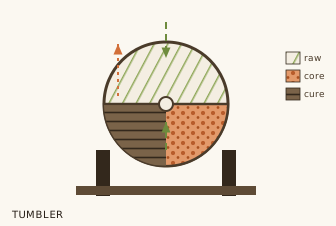
Drawn to the shape of this container and its working volume. Dashed arrows are airflow; hatching is the hot core that holds the temperature curve above.
03Why oak leaves alone never heat up
Oak leaves carry a C:N near 52:1 and, more importantly, a waxy cuticle that sheds water instead of absorbing it. A pile of whole oak leaves will sit at ambient temperature for a year, because the leaf surface never wets and the microbes never get a continuous water film. The fix is mechanical, not chemical: shred to 20-30 mm and pre-wet the shredded leaves for 12 hours before they go anywhere near the bin. In this batch the leaves took up 8 of the 11 L of added water in that pre-soak, which is why the first tumble landed at 54 % moisture instead of the 30 % a dry charge would have given.
04How the C:N landed at 28
The arithmetic is simple enough to do on the back of a seed packet. 22 kg of leaves at 52:1 contributes 22 × 1000 × (52/53) = about 21,580 g of carbon and 415 g of nitrogen. The 6 kg of chaff at 20:1 adds 5,714 g C and 286 g N; the 4.5 kg of grounds adds 4,286 g C and 214 g N. That totals roughly 31,580 g C against 915 g N, or 34.5:1. The 350 g of blood meal at 4:1 contributes 280 g C and 70 g N, pulling the ratio down to about 32:1 — still high, so 2 kg of the grounds were held back and added on day 16 after the first heat had passed. Real batches rarely land exactly on target; what matters is that you can show the working.
05The week-two moisture wobble
By day 6 the pile was at 63 °C and visibly dry at the vent — a tumbler in full sun loses 2-3 L of water a week to evaporation. The mistake here was adding all 3 L at once on day 4; the water ran straight through the centre channel and pooled in the lower chamber. The correction was to add the remaining water in two passes with a 10 minute gap, tumbling between them, which let the chaff absorb it rather than shed it. Squeeze test afterwards: a handful from the middle of chamber A held together and left a faint sheen on the palm, no drips.
06What the temperature curve is telling you
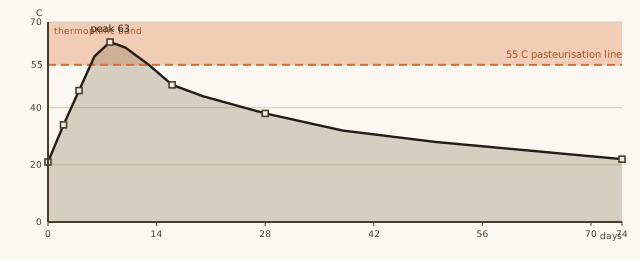
The 63 °C peak on day 8 is the useful part of this batch. Three consecutive days above 55 °C is the working thresholds for knocking back weed seeds and most tomato and pepper pathogens, and this batch held that band from day 6 through day 10 — four days. The long plateau from day 16 to day 28 at 44-48 °C is the second, slower wave as the chaff and grounds break down. Below 35 °C from day 33 onward, the pile is curing rather than composting: keep it damp but stop trying to make it hot.
07Screening and what came out
74 days after the first charge, 96 L of finished compost came off a 12 mm screen, plus 14 L of oversize leaf stems and avocado stones that went back as starter. Moisture at screening was 41 %, so the batch lost about 13 points of water over the run. It went onto a rhubarb bed at 3 L/m² in late August and onto the asparagus bed as a 4 cm mulch.
08Turn schedule
- day 0 Charge chamber A, tumble 20 revolutions to mix, leave lid cracked 2 cm for the first 36 hours.
- day 2 First full tumble, 15 revolutions. Note the smell at the vent — should read like wet forest floor, not vinegar.
- day 4 Tumble 15 revolutions, add 3 L water in two passes with a 10 minute gap.
- day 8 Tumble 15 revolutions. Peak heat reached on day 8 at 63 °C.
- day 16 Tumble and move the whole charge to chamber B; rinse chamber A and let it dry in the sun.
- day 28 Tumble every 4 days from here to the finish — heat has dropped below 40 °C.
- day 74 Screen at 12 mm, return the oversize to the next batch as starter.
09Temperature curve, as it ran
Smell notes
Day 5 the vent smelled faintly of ammonia for about six hours after the water addition — a sign the blood meal was releasing fast while the pile was still below 50 °C. Two extra tumbles that evening cleared it. From day 9 onward the smell was sweet and earthy, and the finished batch smelled like damp oak floorboards with a mineral edge.
10Questions this batch raised
- Can I run this batch without the blood meal?
- Yes, but expect a slower start and a longer cure. Swap it for 1.5 kg of fresh grass clippings or 2 L of urine diluted 1:4, both of which push the same nitrogen without the ammonia spike risk.
- The tumbler stalled at 40 °C in week three — is the batch dead?
- No. A tumbler loses heat fast because the shell is thin and the volume is small. Warm it by moving the whole charge into one chamber, adding 1 kg of fresh greens and tumbling. If it still does not move within 48 hours, the moisture is wrong — check the squeeze test before adding anything else.
11Faults this batch illustrates
- The pile will not heatTemperature sits within 5 °C of ambient for a week or more. The material looks fine and does not smell.
- Ammonia smellA sharp, cleaning-product smell at the vent or when the lid is opened, often strongest in the first week.
- Pile is dry and crumblyThe material crumbles rather than clumps, the surface looks dusty, and the temperature is below 40 °C.