Method · sealed bucket · posted 29 Oct 2026
Bokashi or a worm bin: choosing by household, not by preference
Both handle kitchen waste indoors, both fit under a counter, and they fail in completely different ways. Four questions decide which one is right, and for many households the answer is neither.
01The sheet
| material | kg in | C:N | water | role | carbon |
|---|---|---|---|---|---|
| Cooked food, meat, fish, dairy (bokashi only) | 6.0 | 12:1 | 70% | green | 5.5 |
| Fruit and vegetable trimmings (both) | 14.0 | 17:1 | 82% | green | 13.2 |
| Shredded paper bedding (worm bin only) | 5.0 | 175:1 | 8% | brown | 5.0 |
| Bokashi bran (bokashi only) | 1.4 | 22:1 | 28% | balancer | 1.3 |
| Blended | 26.4 | 19:1 | 62% | 25.1 kg C-eq | |
02Batch facts
- Bin
- sealed bucket
- Thermal class
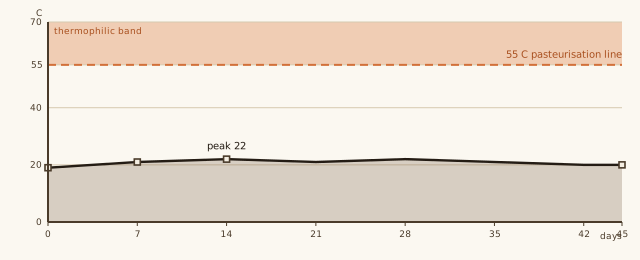
- Mesophilic (stayed below 55 °C)
- Turns
- 4
- Days to finish
- 45
- Target C:N
- 20:1 (as charged 19:1)
- Moisture at build
- 70 % (as charged 62 %)
- Odour risk
- medium
- Space needed
- Either two 20 L sealed buckets indoors, or a four-tray worm system — both fit under a kitchen counter.
- Time to finish
- 14 days in a bokashi bucket plus 6-8 weeks buried; a worm tray is continuous with harvests every 6 weeks.
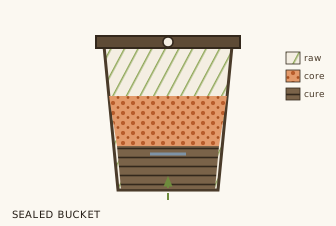
Drawn to the shape of this container and its working volume. Dashed arrows are airflow; hatching is the hot core that holds the temperature curve above.
03Question one: do you cook meat and fish at home?
This is the decisive question. Bokashi handles everything a kitchen produces — cooked food, meat, fish, bones, dairy, oily things — because it is a fermentation, not a decomposition. A worm bin handles none of those: they rot, smell and attract rodents and flies. A household that cooks meat three times a week is a bokashi household. A household that mostly eats vegetables and wants a continuous supply of high-quality castings is a worm household.
04Question two: how much do you produce?
A four-tray worm system with a 1.2 kg worm population handles about 700 g a week, as recorded in the worm log entry in this site. A two-person household producing 4-6 kg of food waste a week needs either a large worm system, three bokashi buckets in rotation, or a combination. Overloading is the single most common reason both systems fail, and it fails slowly: the problem appears three weeks after the overfeeding started.
05Question three: are you willing to handle the output?
Bokashi output is wet, acidic and needs somewhere to go — a trench, a compost heap, or a large planter. If you live in a flat with no outdoor space at all, bokashi solves the indoor storage problem and creates an outdoor disposal problem. Worm bins produce a dry, clean, finished product you can use directly on indoor plants or balcony pots. If you have no soil to put anything into, neither system closes the loop, and a shared building compost scheme may be the better answer.
06Question four: what temperature is the space?
Worm bins need 15-25 °C year round and die above 30 °C. Bokashi buckets do not care — fermentation continues at 10 °C, just more slowly. A flat with a cool kitchen corner in a temperate climate suits worms better; a flat that reaches 28 °C in summer, or a garage that drops below 10 °C in winter, suits bokashi. Getting this wrong is the most expensive mistake because it kills the worm population rather than merely slowing it down.
07Turn schedule
- day 0 Bokashi: fill, press down, seal. Worm bin: fill the tray with moist bedding and bury food in a corner.
- day 7 Bokashi: drain the leachate and check the smell. Worm bin: check for fruit flies and fluff the bedding.
- day 14 Bokashi: the bucket is ready to bury. Worm bin: continue feeding at the established rate.
- day 45 Bokashi: the trench is planted over. Worm bin: harvest the first tray of castings.
08Temperature curve, as it ran
Smell notes
The two systems smell completely differently when they are working. A bokashi bucket smells of pickles and cider; a worm tray smells of wet forest. When they fail, the bokashi bucket turns to rotten eggs — a sign the anaerobic fermentation has been overwhelmed by putrefaction, usually from too much liquid. The worm tray turns to vinegar and then to ammonia as food accumulates faster than the worms can process it. Neither failure is dangerous, and both are corrected by removing the excess.
09Questions this batch raised
- Can I run both?
- Yes, and it is the best arrangement for many households: meat, fish and dairy go into the bokashi bucket, vegetable trimmings and coffee grounds go into the worm tray. The bokashi output then gets buried or added to the outdoor compost, and the worm castings go to the pots and the seed-raising mix.
- Which one is more work?
- Bokashi is less frequent but heavier: one fill, one drain and one burial every two weeks. Worms are a small daily or every-other-day task that never gets heavy. Households that travel a lot do better with bokashi because a bucket can sit sealed for a month; a worm tray cannot be left unfed that long in summer.
10Faults this batch illustrates
- Fruit flies around the worm traySmall flies in the air around the tray, and maggots in any food that is sitting on the surface.
- Bokashi bucket smells rottenRotten eggs, sewage or a strong faecal smell when the bucket is opened, instead of the expected pickle smell.
- Worm tray has gone wet and smellsLiquid at the bottom of the tray, bedding that drips when squeezed, and a sour or ammonia smell.